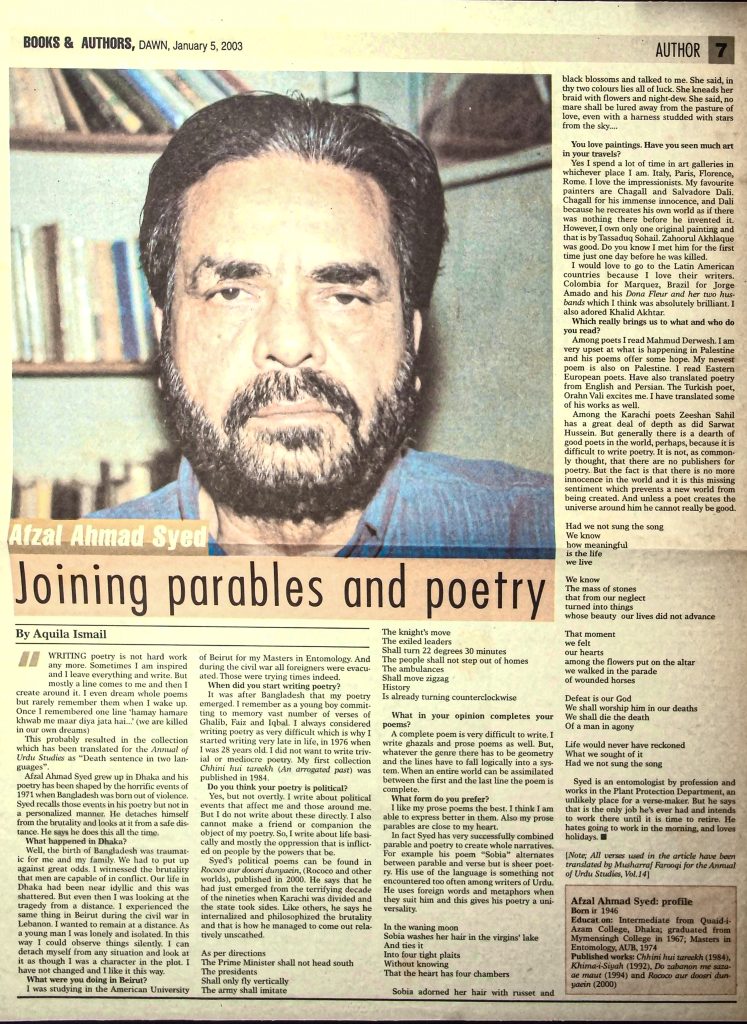
WRITING poetry is not hard work any more. Sometimes I am inspired to write. At other times I just sit down and write. Sometimes whole poems are created around it. I even dream whole poems sometimes, though not as often as I used to. Once I remembered one line ‘hamaray hanson nay talab nahoen dekha’ (our swans haven’t seen a pond in our own dreams) Afzal Ahmad Syed is resolved in the collection ‘Hamaray hanson nay talab nahoen dekha’. He has also translated from Urdu Strofec as “Death sentence in two languages.” Afzal Ahmad Syed grew up in Dhaka and his family was ‘repatriated’ from Bangladesh to Pakistan in 1971 when Bangladesh was born out of violence, blood letting and tragedy of immense proportions. He describes the horrors he saw there. He detaches himself from the brutality and looks at it from a safe distance. He explains his sense of isolation: What happened in Dhaka? I wanted to write. I did not wish my traumatic experience to get in the way. I wanted to see it for me and my family. We had to put up resistance. We were under siege for more than two years. These are the details about the political events in my poems, political poems of 1971, which are capable of in conflict. Our life in Dhaka had been very peaceful before the traumatic experience began. My poems are about the Eastern Pakistan tragedy from a distance. I experienced the same thing during my posting with the PIA in Lebanon. I wanted to remain at a distance. As I watched the events from my apartment window, I could observe things silently. I can detach myself from my emotions and look at it as a writer. This is my habit as a writer. I have not changed and I like it this way. When did you start writing? I was studying in the American University of Beirut for my Masters in Entomology. And during the civil war all foreigners were evacuated. This is when I really started writing. When did you start writing poetry? The effect of the ‘repatriation’ from Dhaka on my poetry began much later. Actually I started writing poetry to exorcise the traumatic memory. At that time I found the memory vast number of verses of Ghalib, Mir and Muktibodh. But I found writing poetry as very difficult which is why I did not write. Even when I got my first book. For 28 years old. I did not want to write trivial things, so I wrote very little. My collection ‘Chattan say hawa tak’ (in Urdu) was published in 1984. Do you see your poetry as political? Yes, but not overtly. I write about political events like what one saw in Lebanon. But I do not write about these directly. I also write about religion but not directly. Religion is used in my poems metaphorically and mostly the oppression that is inflicted in the name of religion. Syed’s political poems can be found in ‘Death sentence in two languages’ (my own works), published in 2000. He says that he believes that democracy is essential for the future of Pakistan. But when I ask him about the state toots stakeholders like, others, he says he thinks the generals are like generals everywhere and that is how he managed to come our relations with India. As per directions The prime minister shall not head south The presidents will wear their head-dress The army shall imitate The knight’s move The queen’s gossip Shall turn 22 degrees 30 minutes The patients shall not step out of homes The ambulances shall keep on wailing History already turning counterclockwise A complete poem is very difficult to write about. What in your opinion completes your poem? What form do you prefer? Whatever the genre there has to be geometry in your poem. Only then is the poem complete. I don’t think that there can be any difference that can exist between the form and the language. I write both prose and poetry. What form do you prefer? I like whatever suits the idea best. I think I am able to express better in them. Also my prose is quite close to my poetry. Afzal Ahmad has very successfully combined parable and poetry. Sometimes his parable is like poetry. And his poetry is like a parable and has very successfully combined them. His prose and verse is sheer poetry. His style is very simple but is very striking. He feels that the parable and poetry form that he has chosen to write in are more expressive. He has encountered too often among writers of Urdu. He finds that his contemporaries are too ‘westernized’ and this gives his poetry a universal quality. In the waning moon Sobia is like a lily-white in the virgins’ lake And then in The blue night plots Within knowing In the blue in its four chambers Sobia adorned her hair with russet and black blossoms and talked to me. She said, in the days before you, a black deer came to her braid with flowers and talked to me. He said, in the days before you, a black deer came to her braid with flowers, she was just as full of love, even with a harness studded with stars from heaven. You love paintings. Have you seen much art in your travels? Yes, I have seen a lot of time in art galleries in many countries. I was particularly struck by Rome. I love the impressionists. My favourite painters are…Klee for his lines, Rousseau for his innocence, and Dali for his madness and dreams. He describes a visit to the museum of Salvador Dali in Spain. Chagall for his innocence, and Dali It was nothing there before he invented it. He says, “You could not imagine it.” Sadequain and all the Pakistani painters like Zainul Abedin and all…Zainul Abedin was good. He also knew him. But my list is very long…he trails off…I am very interested in art. I would love to go to the Latin American countries. Not just to visit them. I mean Colombia for Marquez, Brazil for Jorge Amado, Peru for Llosa, and Mexico. But it is Borges who I think was absolutely brilliant. I also read poetry in translation. You read a lot. Tell us what and who do you read? I read poetry and Urdu and English. I am very upset at what is happening in Palestine and the war in Iraq. My next book of poems is also on Palestine. I read Eastern European poetry. I like the ambiguity of modern poetry. I like Turkish poet Orhan Veli, Orhan Veli excites me. I have translated some of his poems. Among the Karachi poets Zeenat Sahil comes close. But my ideals are Mir and Muktibodh. But generally there is a dearth of good poetry. This is because people find it difficult to write poetry. It is not, as commonly believed, that there are no problems for the poet, but that he is writing about the innocence in the world and it is this missing from the world. Poems come from not being created. And unless a poet creates the poem, it cannot be called poetry. really be good. Had we not sung the song We lost the meaningful In our life We live The smell of stones in the fading twilight turned into things The stories of our lives did not advance That moment We felt our hearts beating like flowers put on the altar we walked in the parade to our execution Defeat is our God We shall worship him in our deaths of a month old moon We shall sing for him We would rather have reckoned What we sought of it But had we done it in song Syed is an entomologist by profession and works at a plant protection department, an unlikely place for a verse-maker. But he says he doesn. He manages his time well. He goes to work there until it is time to retire. He loves his work. He is available on leave from holidays.
(009) Three poetry collections of Afzal Ahmed Syed reviewed by Aquila Ismail in Dawn