
Towards a violent Gujarat
WEBSITE REVIEW
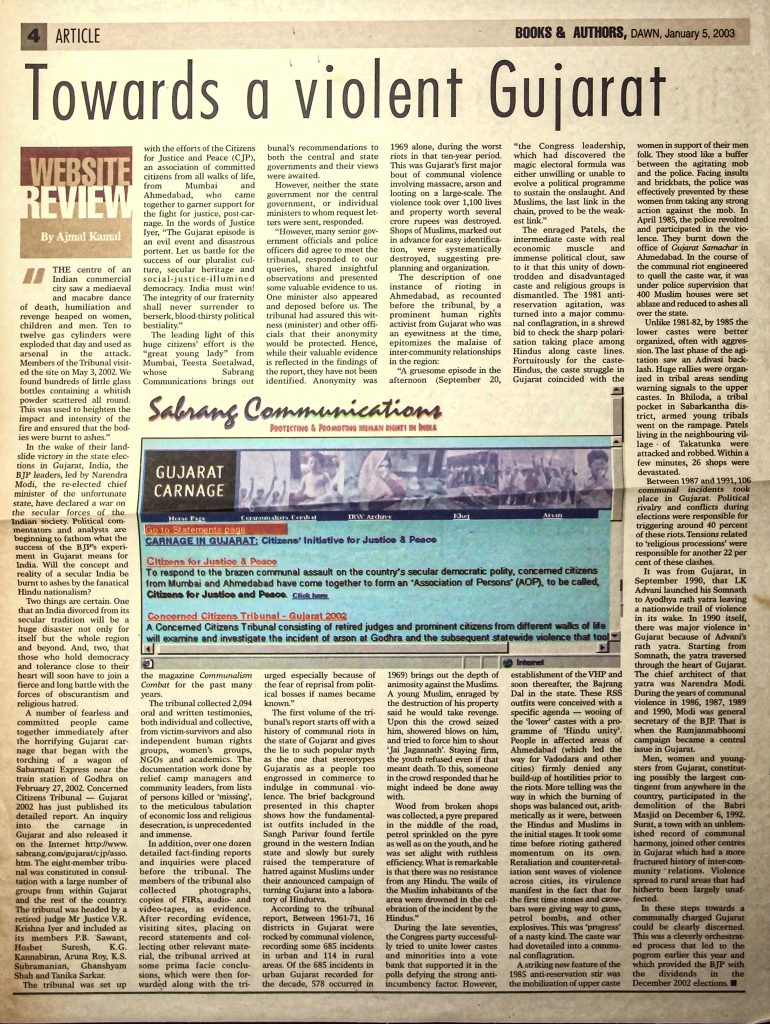
The centre of an ancient city saw a medieval style carnage. Scenes of death, humiliation and destruction were enacted on children and men. Ten to twelve gas cylinders were burst the day the Hindus had arrived in the attack Sabrang and its website hosted the site on May 5, 2002. We found that hundreds of kerosene bottles containing a whitish solution were found at the site. This was used to heighten the flames after setting on fire gas cylinders and kerosene bottles were burnt to ashes.” In the post Godhra landslide victory in the state elections in Gujarat, under the BJP leaders, led by Narendra Modi, five prominent citizens have come together and have declared a war on the communal fascist political Indian society. Political commentators and analysts are beginning to fathom what the victory of the BJP means, not just for Gujarat, but for India. Will the concept and weight of a secular India be burnt to ashes by the fanatical ‘Hindutva’ politics? Two things are certain. One that this is certainly not the last we have seen of the fire, or a huge disaster not only for India but for South Asia and beyond. And, two, that those who value secularism and tolerance close to their hearts will never surrender to these dark and threatening forces of obscurantism and religious hatred. A number of fearless and dedicated citizens came together immediately after the large-scale killings and carnage that began with the burning of a coach of Sabarmati Express in Godhra train station of Gujarat on February 27, 2002. A ‘Concerned Citizens Tribunal — Gujarat 2002’ has now published a detailed report. An inquiry into the carnage in Gujarat on the Internet http://www. online. com. The eight member tribunal was constituted in consultation with a large number of groups from within Gujarat and the rest of the country. The Tribunal was headed by Justice Krishna Iyer. Justice Krishna Iyer and included as its members P.B. Sawant, K.G. Kannabiran, Aruna Roy, Dr. Subramaniam, Ghanshyam Shah and Tanika Sarkar. The tribunal was set up with the efforts of the Citizens for Justice and Peace (CJP), who put together a list of 800 citizens from all walks of life, from academics to Ahmedabad, who came together to gather support for the CJP and for the ‘inquiry’. In the words of Justice Iyer, “We shall not sleep over an evil event and disastrous development resulting from the success of our pluralist culture. Secularism, basic feature of the Constitution and democracy India must win! We, the people of India shall never surrender to the dark, demonic forces of communalism.” “The healing light of this report” given form in the “great young lady” from Gujarat, Teesta Setalvad, whose Sabrang Communications brings out bunal’s recommendations to both the central and state governments. Copies of these were awaited. Whether either the state government or the central government, or individual concerned, to whom these letters were sent, responded. The report listed all the government officials and police officers who had, before this tribunal, requested to be heard or proved insightful were persons who gave ‘invaluable evidence’ to us. The list contains 2,094 witnesses and deposed before us. Unlike the non-government witness and other officials who gave supporting evidence, it would appear while their valuable evidence is ‘buried’ in the volume of the report, they have not been identified. 1969 alone, during the worst riots in that ten-year period. Then, in Gujarat, 1980, a bad bout of communal violence. In a single outbreak, nine lives were lost. In Ahmedabad, the violence took over 1,100 lives and property worth over 4 crore rupees was destroyed. Many of the instances reveal, in advance for easy identification of the minority, fully documented reports, preplanning and organisation. For the first time, for instance, in rioting in Ahmedabad, 23 incidents before the tribunal by a prominent activist from Gujarat. This was mentioned in the report, but was not part of the ‘evidence’. A gruesome episode in the afternoon September 26, 1969 alone, during the Congress leadership, which had discovered the ‘Gujarat formula’ of engineering either unwilling or willing riots between two broad programme of divide and rule, upper caste Muslims, the last link in the chain, even down to the lowest sub-caste link. This enraged Patels, the intermediate caste with real power. They launched a ‘save reservation’ drive adding to it that this unity of down trodden and intermediate caste and religious groups is responsible for the ‘pro-reservation agitation, was communal’. For the first time, the state machinery was seen to bid to check the sharp polarisation between the Savrila Hindus along caste lines. Unlike the riots in rural Hindu, the caste struggle in Gujarat coincided with the women in support of their men folk. They stood like a buffer between the attacking mob and the police. Hurling stones and brickbats, the police was also made ineffective. Young women from taking any strong action. During this time, in April 1985, the police revolted and subsequently, all the offices of CJP were burnt down. In Gujarat then, it was clear that the state police, in the communal riot engineered by Congress state government, under police supervision that ‘the state machinery’, went up ablaze and reduced to ashes all that was ‘just’. In the rural areas, the lower castes were better organised than in the urban areas. The last phase of the agitation, in Ahmedabad, was lush. Huge rallies were organised by ‘Dalits’ that sounded warning signals to the upper castes. On May Day, a ‘tribal rally’ was organised in the district, armed tribal groups went on rampage and plundering in the neighbouring villages. Properties were attacked and robbed. Within a few days, all riots were brought down. “Between 1987 and 1991, 106 communal incidents took place in Gujarat. Political actors and small, state-level elections were responsible for triggering off riots in Gujarat, where ‘both political parties’ to ‘religious processions’ were responsible for close to 20 per cent of these clashes. “It was only in Gujarat, in September 1990, that the ‘rath yatra’ from Somnath to Ayodhya led to a nation-wide trail of violence … In 1990, in Gujarat, there was major violence’ in areas covered by Advani’s rath yatra. Starting from Gujarat, the yatra moved through the heart of Gujarat violence for several days Gujarat. During the years of communal conflicts in 1987, 1988, 1989 and 1990, Modi was general secretary of the BJP and it is when the Ramjanmabhoomi campaign was at its peak,” Modi launched Men, women and youngsters from coastal areas, joining possibly the largest contingent from any state in the country, participated in the demolition of the Babri Masjid on December 6, 1992, joined hands in this ‘national cause’. As a result of this, harmony, joined other communal riots that ripped apart, fractured history of inner-conflicts, that let communal spread to rural areas that had been, for long, peaceful,” said. In these steps towards a ‘communal agenda’, there could be clearly discerned. This was a long term, planned process that led to the present phase, “the agenda” which provided the BJP with a landslide victory in December 2002 elections.
