
Press History seen by a journalist
Kamal Habib
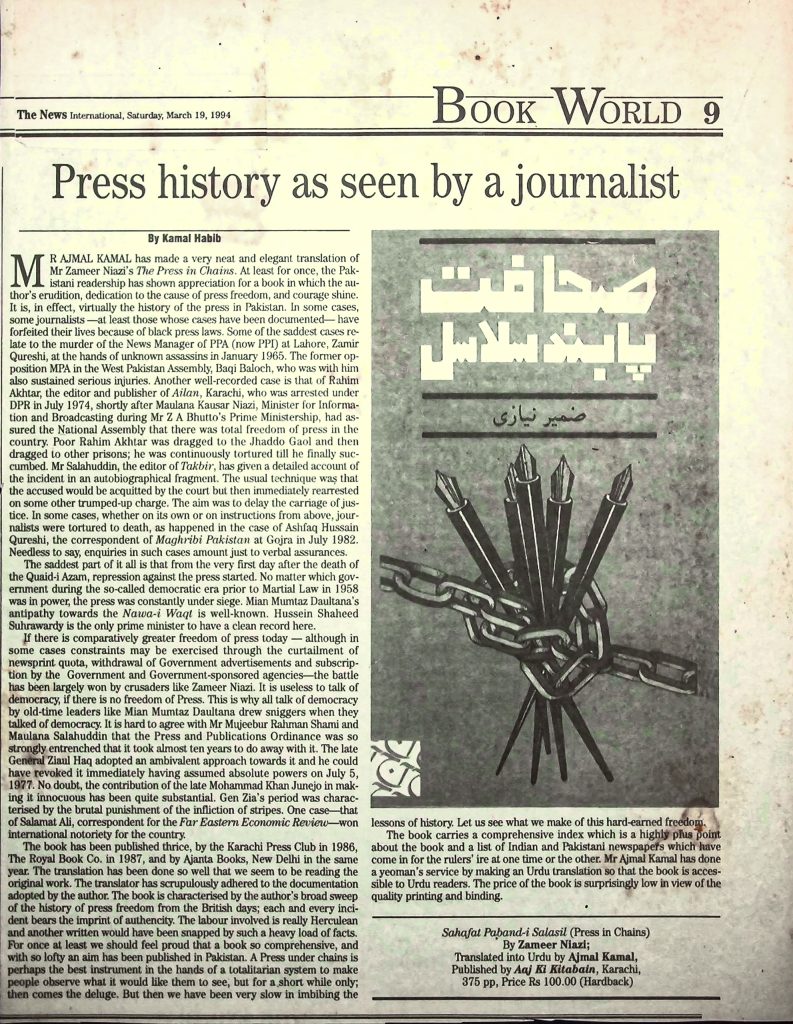
MR. AJMAL KAMAL has made a very neat and elegant translation of Mr Zameer Niazi’s The Press in Chains. At least for once, the Pakistan leadership has not shown any attention for a book in which the author’s erudition, dedication to the cause of press freedom, and writing ability. It is, in effect, virtually the history of the press in Pakistan. In some cases, some journalists—or journalist-like persons connected with newspapers—forfeited their lives because of black press laws. Some of the saddest cases relate to the murder of the News Manager of PPA (now APP) in Lahore, Javed Aligazi, son of the leader of universal fame Majlis Ahrar, 1965. The former opposition MPA in the West Pakistan assembly, Baiji Baloch, who was with him was sustained serious injuries. Another well-known case is of Alhaj Rabani Akhtar, the editor and publisher of Ailan, Karachi, who was arrested under DPR in June 1974. Zameer Niazi has been precise about the Minster of Information and Broadcasting during Mr Z A Bhutto’s Prime Ministership, had assured the National Assembly that there was total freedom of press in the country. Alhaj Rabani Akhtar was dragged to the Gaddafi stage and was dragged to other prisons; he was conspicuously tortured till he finally succumbed. Mr Rabbani was the editor of Insaf in August as a detialed account of the incident in an autobiographical fragment. The usual technique was that the accused would be enlarged on bai, would then immediately be arrested on some other trumped-up charge. The aim was to delay the carriage of justice. In some cases, whether on its own or on instructions from above, journalists were refused bail. Perhaps the gloomiest case relates to Abbas Qureshi, the correspondent of Maghrbi Paksitan of Gojra in July 1982. Needless to say inquiries did not throw any light as to who done it. The saddest part of it all is that from the very first day after the death of the Quaid-i-Azam, especially when the press and publications ordinance agreement during the so-called democratic era prior to Martial Law in 1958 was in power, the press was constantly under siege. Mumtaz Daultana’s newspaper became the Citizen’s Ward from unknown quantity. Hamid Suhrawardy is the only prime minister to have a clean record here. If there is one lesson to be learned from such a process, although in some cases constraints may be exercised through the curtailment of newsprint quota, withdrawal of Government advertising, threats and corruption by the Government, and government-sponsored agencies—the battle has been largely won by crusaders like Zameer Niazi. It is useless to talk of democracy if there is no freedom of press. This is why the barbs discharged by old-time leaders like Mian Mumtaz Daultana drew sniggers when they talked of democracy as a hard-earned right. Mr Bhutto’s additions included Maulana Salahuddin that the Press and Publications Ordinance was so strongly entrenched that it took almost ten years to do away with it. The late Shahid Kamal had adopted its anniversary issue—the rewards and the field have been revoked. It immediately having assumed absolute powers on July 5, 1977, the coefficient of the coalition of the late Mohammed Khan Junejo in making it innocuous has been quite substantial. Gen Zia’s period was characterised by the worst possible in all the field were available. One good turn of Salamat Ali—correspondent for the Far Eastern Economic Review—won international notoriety for the country. The book has been published twice, by the Karachi Press Club in 1986, the Federal Book Co. in 1987, and by Ajanta Books, New Delhi in the same year. The translation has been done so well that it seems to be reading the original work. The translator has scrupulously adhered to the documentation and letters and drafts. The book provides authentic, comprehensive account of the history of press freedom from the British days; each and every incident bears the imprint of authenticity. The labour involved is really Herculean and one must possess woodpecker-like patience for such a heavy task of facts. For once, at least we should feel proud that a book so comprehensive, and with no softy feelings has been published in Pakistan. A Prize-wider decision perhaps the best instrument in the hands of a totalitarian system to make people behave usually would like them to use one for a short while and then comes the deluge. But then we have been very slow in imbibing the lessons of history. Let us see what we make of this hard-earned freedom. The book carries a comprehensive index which is a highlight point about the book sellers in Pakistan and Pakistan newspapers which have come out for the time are at one time or the other. Mr Ajmal Kamal has done yeoman’s service by providing a Urdu translation so that the book is accessible to Urdu readers. The price of the book is surprisingly low in view of the quality printing and binding.
