
to be found in any academic tome. In India, as elsewhere, journalists both court and are courted by the political establishment. Tavleen Singh avoids all the usual pitfalls of proximity but has to pay the price. Simply because she frequently met and interviewed Farooq Abdullah, the former chief minister of Kashmir, she is hauled up by India’s intelligence. But Ms. Singh’s credibility rests on the fact that she does not allow proximity to political power to cloud her judgements. She is scathingly critical of Farooq Abdullah, who was better known in Delhi as a playboy than a politician. She sees much of the tragedy as a result of mega-political decisions being made on grounds merely as a part of jockeying for power by a small, unrepresentative elite. That is true not only of Kashmir but of politics in the subcontinent in general. For readers to understand a rule psyche is often halfway to understanding policy initiatives in the making. Islamabad’s own foreign policy decision-making process, especially with regard to India, has also been dominated by domestic political concerns, bad judgements and personal whims. Islamabad’s Kashmir policy has been stuck in the same groove since 1989, when the Kashmir Valley exploded. And Islamabad’s denial of the Kashmiris’ right to the third option — independence rather than choosing between India and Pakistan — has now become a noose around Pakistan’s neck. But where the buck stops, even for Ms Singh, is to acknowledge the right of self-determination of the Kashmiris and the fact that Kashmir is a disputed territory between India and Pakistan. The Indian denial of self-determination, born out of fears that it would have a domino effect in the rest of India, is the biggest stumbling block in the way of meaningful negotiations between the two countries. Unless India is able to acknowledge the necessity of self-determination and expounds its military machine out of Kashmir, rights Kashmir will emerge. With both India and Pakistan now possessing nuclear capability, the Kashmir issue is severing the two old enemies, which has already led to two wars, it has become more than just a territorial or political football. It has a destabilising effect across South and Central Asia. Ms Singh has written an erudite and sensitive book that both rulers and the ruled should read, because it exposes misdemeanours on both sides of the political divide. Tales of Courage We have been fed on myths about our birth as a nation. And over the years loving these myths with such loving care that they have acquired monstrous proportions. We have also displayed a wild, furious-larocity, any facts, however boldy or forcefully projected, from making even the slightest dent in any of the myriads of myths that determine our attitudes and responses in any given situation. And in the process we have misstated history beyond recognition, thoroughly corrupted the minds of the younger generations and hopelessly paralysed reason. Myths surrounded the birth of Pakistan, the Kashmir issue, the wars we so listlessly fought with India, our championship of so-called Islamic causes across the world, our eagerness to wear, rehab and manufacture ‘shaheens’ — one could go on. Until lately there had been total, sight and all-envading conformity. But in the past few years there have been, though still nascent, what can be called the “other voices”. One such voice has been forcefully raised with utmost conviction by the compilers of Sarajevo, Sarajevo, the special issue of the elitist magazine Adj. Ajmal Kamal, the moving and guiding spirit behind this evidently ambitious project, fondly calls the issue “Karachi’s homage to Sarajevo”. It looks at and approaches what is probably the modern world’s most lamentable of human tragedies, with rare warmth and understanding. But above all it shatters the myth of religious persecution of Muslims at the hands of Christians that religious parties in Pakistan, led by the Jamaat, have so
studiously woven around the Bosnian tragedy.
All references to crusades and pronouncements of jehad are reduced to so much nonsense when a true picture of the Bosnian problem is brought out in bold relief, as Ajmal Kamal so ably does in his long preface to this special issue. Unfortunately, however, his truly heroic effort is likely to enlighten but a few and the masses in general will continue to be held hostage to the religious parties’ own warped line of thinking.
150
How many of us, contrary to the
falsehood churned out vigorously day in and day out by the religious parties as well as the government of the Islamic Republic, would wake up to the historical fact vehemently underscored in the Aaj issue that Bosnia is not a Muslim country: the Muslims are in a minority and it is a tribute to the secular democratic traditions of that tiny enclave in the Balkans that a Muslim (minority) dominated political set-up is in charge of its affairs. Or that the mandate or objective of the administration of President Izzetbegovich is not to protect a religious (Muslim) community
against the ravages of another, or to retain the mythical Islamic character. of Bosnia-Herzegovina against the ravages of its savage, godless neighbours. No. What he and his government are trying to do in the face of openly belligerent foes and purposely or innocently misguided friends, is to somehow retain the multi-ethnic, multi-religious entity that Bosnia has been for generations. Unfortunately, that’s not what the gods of today’s new world dispensation want or wish to happen. The others, with the Serbs and occasionally the Croats too in
the forefront and the mighty N.A.T.Ο. powers god-fathering them, have only one objective in view the balkanisation of the Balkans through the ferocious military machine that the Serbs have been for ages and still are today. There is no religion or ethnicity involved. Bosnia, like most countries of the unfortunate Third World, simply happens to be in a place and time where the self-ordained designers of a future world order do not want it to be.
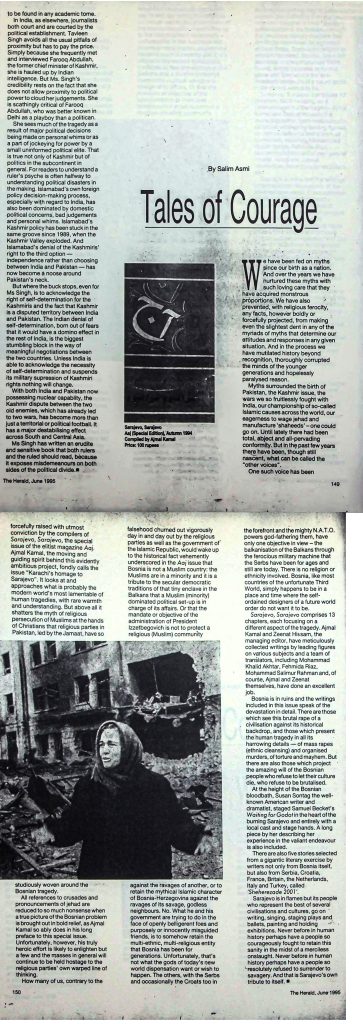
Sarajevo, Sarajevo comprises 13 chapters, each focusing on a different aspect of the tragedy. Ajmal Karnal and Zeenat Hissam, the managing editor, have meticulously collected writings by leading figures on various subjects and a team of translators, including Mohammad Khalid Akhtar, Fehmida Riaz, Mohammad Salimur Rahman and, of course, Ajmal and Zeenat themselves, have done an excellent job.
Bosnia is in ruins and the writings included in this issue speak of the devastation in detail. There are those which see this brutal rape of a civilisation against its historical backdrop, and those which present the human tragedy in all its harrowing details of mass rapes (ethnic cleansing) and organised murders, of torture and mayhem. But there are also those which project the amazing will of the Bosnian people who refuse to let their culture die, who refuse to be brutalised.
At the height of the Bosnian bloodbath, Susan Sontag the well-known American writer and dramatist, staged Samuel Becket’s Waiting for Godot in the heart of the burning Sarajevo and entirely with a local cast and stage hands. A long piece by her describing her experience in the valiant endeavour is also included.
There are also five stories selected from a gigantic literary exercise by writers not only from Bosnia itself, but also from Serbia, Croatia, France, Britain, the Netherlands, Italy and Turkey, called ‘Sheherezade 2001.
Sarajevo is in flames but its people who represent the best of several civilisations and cultures, go on writing, singing, staging plays and ballets, painting and holding exhibitions. Never before in human history perhaps have a people so courageously fought to retain this sanity in the midst of a merciless onslaught. Never before in human history perhaps have a people so resolutely refused to surrender to savagery. And that is Sarajevo’s own tribute to itself.
The Herald, June 1995
