
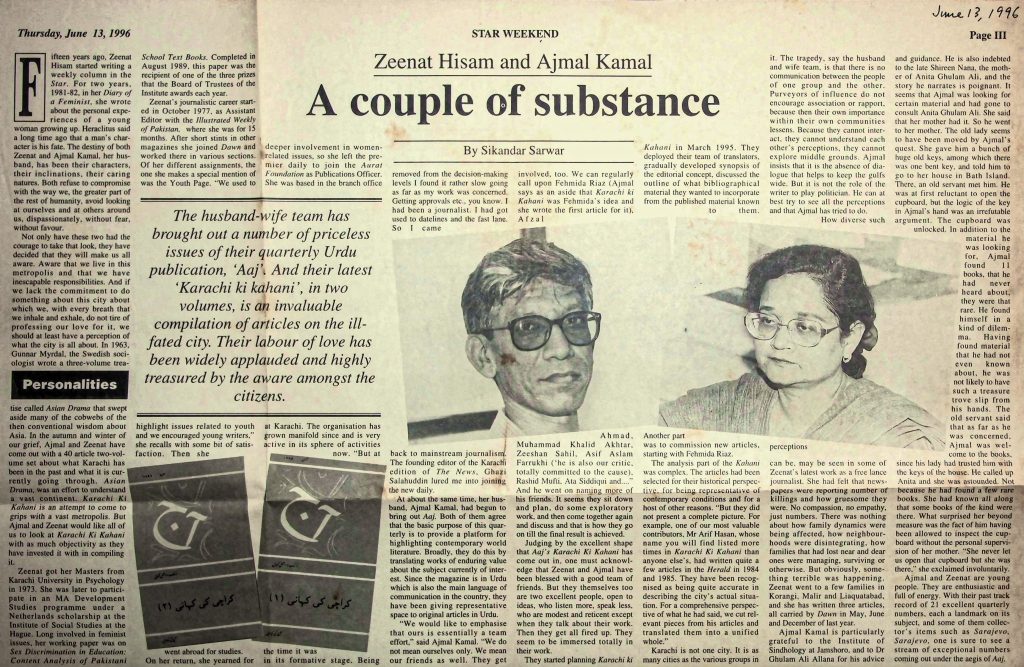
deeper involvement in women-related issues, so she left the pre-ss to work as programme co-ordinator at Foundations as Publications Officer. She was based at the branch office back to mainstream journalism? The founding editor of the Karachi issue, a friend of ours, Ghazi Salahuddin hired me into joining the new daily. Around the same time, her hus-band, Ajmal Kamal, had begun to bring out ‘Aaj’, both of them agree that the main objective of this qtrly is to provide a platform for highlighting contemporary issues. But ‘Aaj’ attempts to do this by translating works of eminence while ‘Karachi’ limits its domain to this city alone, and is done in Urdu with which is also the main language of communication. ‘In a way, we have been giving representative space to original articles in Urdu.’ ‘Yes, and I must emphasize that ours is essentially a team effort,’ said Ajmal Kamal.’We do get contributions for free from all our friends as well. They get removed from the decision-making level I found it rather slow-going. It was more like administration, getting approvals etc, you know. I had been a journalist. I had got into it and this was what I wanted. So I came involved. And we get contributions from Mohammad Khalid Akhter, Zeeshan Sahil, Asif Farrukhi… Ata is also our critic. We get contributions from Attiya Daud, Rasheed Malik, Ala Siddiqui etc…’ And it’s a very ‘taxing, more of a labour of love than anything else,’ said Zeenat, and they ‘plan, do some exploratory work, and then come together again, and again, and again. And we go on till the final result is achieved.’ ‘Highlighting contemporary issues’ does sound a bit cliche, but as one came out, one must acknowl-edge that Karachi and Pakistan have been blessed with writers and reaso-ned friends. But they themselves too are very selective, gentle, liberal in ideas, who listen more, talk less, who are modest and reticent about their own self and work, even. Then they get all fired up. They seem to be immersed totally in their work.’ They started planning Karachi in involved, too. We can regularly call upon Fehmida, Imtiaz Alam, Asma, and Ghazi Salahuddin. It all started when Fehmida’s idea and she wrote the first article for us, on T.V. Kehkashan in March 1995. They displayed their team of translators, and Zeenat Hisam did an article based on the editorial concept, discussed the outlines of what Subhra(something) had written about Karachi, drawing upon the published material known to them. Along with Fehmida, they were collaborating with new artists. Another pat perceptions of the Kda/kmc. They set the tone for the city, analysed the historical perspec-tive, its changing representation of different ethnic, linguistic groups, and other reasons. ‘But they did not present a complete picture,’ for example, ‘one of our main valued contributors, Mr Asif Hasni, whose name you will find listed some-where,’ ‘he did not get to speak and anyone else’s, had written quite a few articles in the Herald in 1984 and 1985. They have been reprinted as being quite accurate in their depiction of the city’s decima-tion. For a comprehensive perspec-tive of what has to be said, ‘our ret-icence, shyness and reservation gets translated then into a unified whole.’ Karachi is not one city, it is as many cities as the various groups in it. The tragedy, says the husband and wife team, ‘is there is no real communication between the people of one group and the other.’ Though ‘Aaj’ and ‘Karachi’ attempt to encourage association or rapport, words come from their own experience as well. They do not seem to communicate. Zeenat, for example, cannot intervene in Ajmal’s description of ‘Karachi’s’ mobile perceptions. They sit almost side by side, and the little girl from collage that helps to keep the gulls wide. That is not the role of the wife. But that is Zeenat’s view, too. I try to see all the perceptions and that Ajmal has tried to do.’ They discuss with audience. He is also indebted to the guidance of the late wife of Aslam Ghilani Ali, and the story he narrates in progress is also based on her life. She had got certain material and had gone to consult Aslam Ghilani Ali. She used to carry a huge bunch of keys, like her mother. The old lady seemed to be always in search of a key to some box. ‘I have seen this bunch of keys,’ said Ajmal, ‘among which there is also the key to a cupboard. I used to go to her house in Bath Island. There, an old servant-man, logic he has been with them for 40 years, opens the cupboard, the logic is on him. The key is in Ajmal’s hands. He tries to open the cupboard. The cupboard can be unlocked.’ In addition to the material he was looking for, Ajmal found many books that he had never seen, or heard of. They were rare. He found them by acci-dent, or kind of dim illumination. Having found the key that he had not even known about, he is not likely to leave such a treasure-trove out of his hands. The old servant-man had told him the box was concerned, Ajmal, too. It led him to the books. Since his auntie had trusted him with the keys… Ajmal’s father was an engineer. He, Attia and the whole… generation. Because he had found a few rare books, he could not go… he points out that ‘some books of the land were there. What surprised me beyond measures was that why had they been allowed to almost inspect the cap-tured, abandoned property as well?’ He is sorry… as her mother. ‘She never let us open that cupboard but she was not… They are Zeenat and Ajmal. Ajmal and Zeenat are young people. They are enthusiastic and have already brought out their record of 21 excellent quarterly numbers, each a landmark on its own… apparently, besides bring-ing out items such as ‘Sarajevo’, interpretations… the region (like)… coming out under the aegis of ‘Aaj’.
