
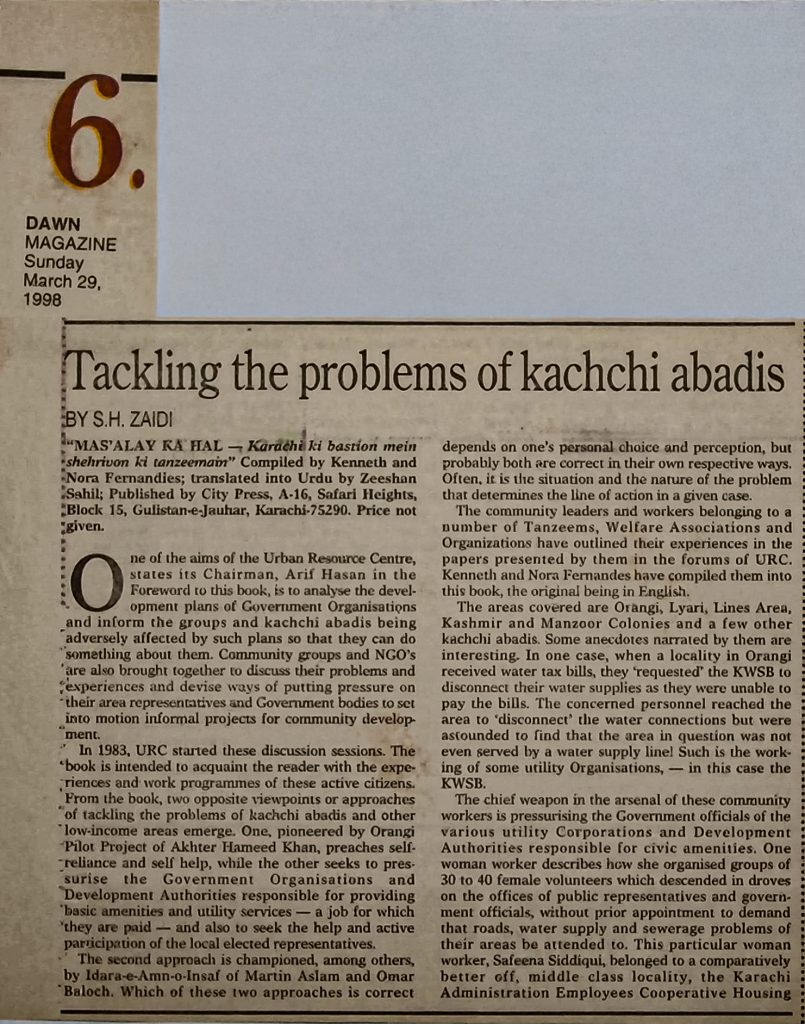
Tackling the problems of kachchi abadis ne of the aims of the Urban Resource Centre, states its Chairman, Arif Hasan in the Foreword to this book, is to analyse the development plans of Government organisations and inform the groups and kachchi abadis being adversely affected by such plans so that they can do something about them. Community groups and NGO’s are also brought together to discuss their problems and experiences and devise ways of putting pressure on their area representatives and Government bodies to set into motion informal projects for community development. In 1983, URC started these discussion sessions. The book is intended to acquaint the reader with the experiences and work programmes of these active citizens. From the book, two opposite viewpoints or approaches of tackling the problems of kachchi abadis and other low-income areas emerge. One, pioneered by Orangi Pilot Project of Akhter Hameed Khan, preaches self-reliance and self help, while the other seeks to pressurise the Government Organisations and Development Authorities responsible for providing basic amenities and utility services — a job for which they are paid — and also to seek the help and active participation of the local elected representatives. The second approach is championed, among others, by Idara-e-Amn-o-Insaf of Martin Ashton and Omar Baloch. Which of these two approaches is correct depends on one’s personal choice and perception, but probably both are correct in their own respective ways. Often, it is the situation and the nature of the problem that determines the line of action in a given case. The community leaders and workers belonging to a number of Tanzeems, Welfare Associations and Organizations have outlined their experiences in the papers presented by them in the forums of URC. Kenneth and Neri Fernandes have compiled them into this book, the original being in English. The areas covered are Orangi, Lyari, Lines Area, Kashmira and Manzoor Colonies and a few other kachchi abadis. Some anecdotes narrated in them are interesting. In one case, when a locality in Orangi received water tax bills, they ‘requested’ the KWSB to disconnect their water supplies as they were unable to pay the bills. The concerned personnel reached the area to ‘disconnect’ the water connections but were astounded to find that the area in question was not even served by a water supply line! Such is the working of some utility Organisations, — in this case the KWSB. The chief weapon in the arsenal of these community workers is pressurising the Government officials of the various utility Corporations and Development Authorities, responsible for civic amenities. One woman worker describes how she organised groups of 30 to 40 female volunteers which descended in droves on the offices of public representatives and Government officials without prior appointment to demand that roads, water supply and sewerage problems of their areas be attended to. This particular woman worker, Saleema Siddiqui, belonged to a comparatively better off, middle class locality, the Karachi Administration Employees Cooperative Housing
