burupean lalam acquisition of knowledge has top pri
ority. The Mughals failed to establish univerzi ties and colleges or even schools as organised national institutions. The Mughal government did not even have an education department, Even if the examples of Egypt and Morocco with their universities were too distant to inspire the Mughals, Central Asia from where the Mughals came had set up universities, colleges and schools as organised institutions. This was their greatest shortcoming. The scholar around whom students collected to learn could be of limited use. Even the course of studies prepared by Mulla Nizam during the very end of Av Aurangzeb’s rule was uninspiring and was far far behind the courses of study of the Middle Eastern and Central Asian universities of three hundred years ago. It could not produce scientists, philosophers, historians, scholars or even educa tionists. The misfortune is that it is still used in traditional education in Pakistan. It is called Darri-Nizami, the Nizam’s study course. This too was done by individual scholars, not in organ ised educational institu tions.
In fact the situation had reached the stage where it was like a river in massive flood. A dam can he built only after the flood has passed by and the river is amenable to training. That stage came after
the world be confronted with an armed uprising by a people who had failed to consolid and integrate as a nation with a strong social will? Sir Syed was the anly person with rect thinking. But no more Sir Syeds were thrown up by the Muslim society of India in economics, technology and other related fields, The (intellectual) scene was dominated by those weeping for the present or those living on the memories of the glories of the past in distant lands in the Middle East. Instead of negotiating with the present and looking forward to a great future, Indian Muslima negotiated with the
Not that an armed confrontation of an aggres sion is not an (available) option. If properly planned and executed, it is. llur it can be useful and effective only when the public has been politically educated, motivated and mobilised. This is a very long process and requires a lot of devotion and patience. The silker en hazidkerchief movement in 1857 was not preceded by decades of political education. The people were not mbilised in any way. Similar was the case with other movements which were based on an armed struggle. In recent history one (can cite) examples of successful armed options, as in Algeria, Vietnam and China. But all of these had the masses involved in the struggle.
The British annexation of India was consoli dated after the 1857 mutin mutiny, as the Bri it or the war of independence as the Indians called it. It loft Indian Muslims aghast, uned and forlorn in Delhi and what is Utter Pradesh in India. The rest of India remained more or less quiet in the 1857 upsurge, But what affected all the Indian Muslims in varying degrees was their lagging behind in edu cation, business and industry. They came face to face with the problems of a world they were not prepared to face pawad at this stage that the Muslim leaders
was at this stage that ocial attitude what was needed ation ionately study the situa rua problems in all industry, business, all, for the reformation of moral behaviour. In fact, complete social overhaul of society. The Muslim Indian society was able throw up only one leader of stature Sir Syed Ahumad Khan. Sir Syed had the courage to point out to the Muslims some of the ills and weaknesses their society was suffering from. The crucial solution he proposed was to empha The the importance of moderness to emp The odern education. The ners like him. Sir Syed died up with Indian Muslim reformers without any successor of his stature. Education may have been crucial for the Muslims, but it cov ered only one aspect of their life. The most seri problem feudal order and that
beothers in Islam. Nor indeed did they work for peasant education. In fact, they conttmed in dis courage and so often forcibly deterred peasants under their control from acquiring education. Even without higher education, the feudals
were wise enough to realise that educated and economically prosperous peasants would ans day day throw throw away the feudal yoke. The feudals being nobody’s fools did everything to koup the peasants from acquiring either education or prosperity. Perhaps, many amongst the feudals were practising Muslims. In Islam all Muslizas are equal and are each other’s brothers. The feu dals kept this clause of Islam in indefinite abeyance and continued to treat them as serfs and only a shade better than they would treat the slaves.
Feudalisan and lack of education were the most serious problems the Indian Muslims faced. But these After the trauma of losing their special position But these were not the only problems in Indian society after the fall of the Mughal empire. they were suspects under the British, who ousted both the Sikhs and the Marathas. The Muslims were also economically back ward. This gave rise to two dif ferent, but simultaneous, rear-tions. A group of thinking Muslims started writing ale gies and books reminding the Muslims about their fall from their high pedestal. This made a section of the even more depressed and pessimistic, hardly an ideal state of mind to face serious situation.
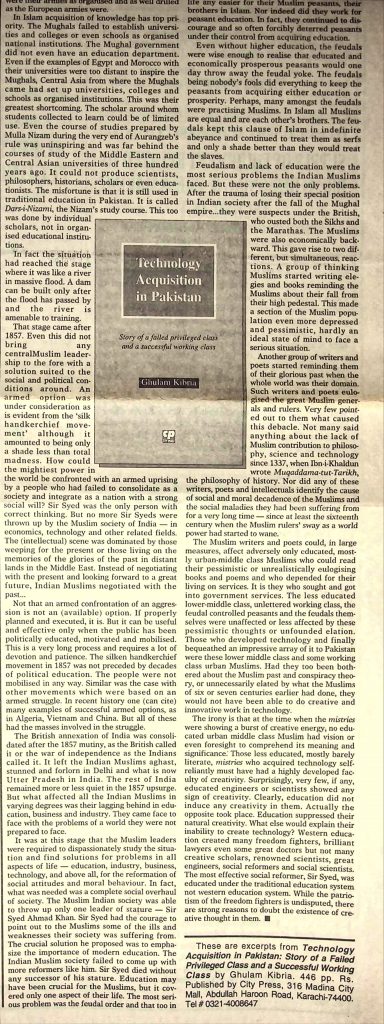
Technology Acquisition in Pakistan
Story of a failed privileged vous and a zaccard working clore
Lihulans Kibria
1857. Even this did not
bring
any
centralMuslim leader
ahip to the fore with a
solution suited to the
social and political con
ditions around. An
armed oprion was
under consideration
is evident from the ‘silk
handkerchief move-
ment although it
amounted to being only
a shade less than total
madness. How could
the mightiest power
Another group of writers and poets started reminding them of their glorious past when the whole world was their domain Such writers and poets eulo gised the great Muslim sener gener als and rulers. Very few point ed out to them what caused this debacle. Not many said anything about the lack of Muslim contribution to philoso phy, science and technology since 1337, when Ibn-i-Khaldun wrote Muqaddama-cut-Tarikh, of history. Nor did any of these the writers, poets and intellectuals identify the cause of social and moral decadence of the Muslims and the social maladies they had been suffering from for a very long time since at least the sixteenth century when the Muslim rulers sway power had started to wane. world
The Muslim writers and poets could, in large measures, affect adversely only educated, most ly urban-middle class Muslims who could read their pessimistic or unrealistically eulogising books and poems and who depended for their living on services. It is they who sought and got into government services. The less educated lower-middle class, unlettured working class, the feudal controlled peasants and the feudals them-selves were unaffected or less affected by these pessimistic thoughts or unfounded elation. Those who developed technology and finally bequeathed seathed an an impressive array an of it to Pakistan were these lower er middle class arul some working class urban Muslims. Had they too boen both an imp about the Muslim post and conspiracy theo ry, or unnecessarily clated by what the Muslima of aix seven centuries earlier had done, they would have been able to do creative and innovative work in technology.
The irony is at the time when the mistries were showing a burst of creative energy, ne edu cated urban middle clats Muslim had vision or foresight to comprehend its meaning and significance. Those less educated, mostly harely literate, mirries who acquired technology self reliantly must have had a highly developed fac ulty of creativity. Surprisingly, very few, if any, educated engineers scientists showed any sign of creativity. Clearly, education did not induce any creativity in them. Actually the opposite took place. Education suppressed their notun creativity. What else would explain their inability to create technology? Weste tion created many freedlogy? Western educa lawyers even sum sume great doctors but not many creative scholars, renowned scientists, great engineers, social reformers and social scientists. The most effective social reformer, Sir Syed, was educated under the traditional education system not western education system. While the patrio tism of the freedom fighters is undisputed, there are strong reasons to doubt the existence of cre ative thought in them. fighters, brilliant
These are excerpts from Technology Acquisition in Pakistan: Story of a Failed Privileged Class and a Successful Working Class by Ghulam Kibria. 446 pp. Rs. Published by City Press, 316 Madina City Mall, Abdullah Haroon Road, Karachi-74400. Tel / 0321-4008847
(039)Technology Acquisiton In Pakistan Review