
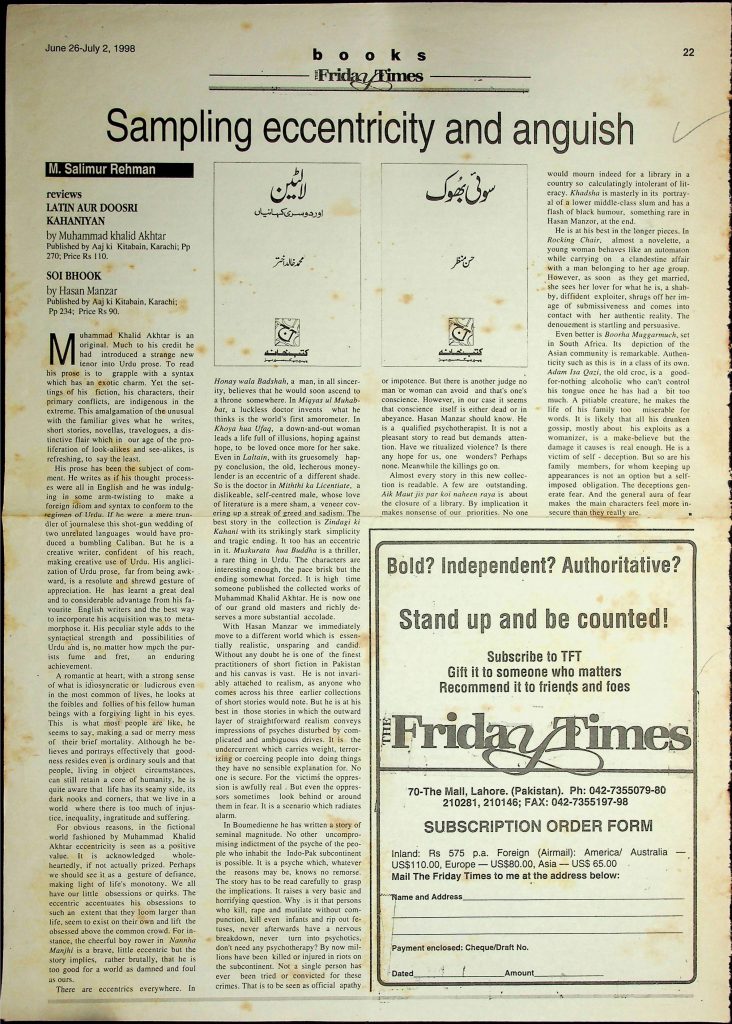
Sampling eccentricity and anguish
M. Salimur Rehman
June 26-July 2, 1998
The Friday Times
LALTAIN AUR DOOSRI KAHANIYAN
by Muhammad khalid Akhtar Published by Aaj ki Kitabain, Karachi: Pp 270, Price Rs 110.
SOI BHOOK
by Hasan Manzar
Published by Aaj ki Kitabain, Karachi: Pp 234: Price Rs 90.
M uhammad Khalid Akhtar is an original. Much to his credit he had introduced a strange new lenor into Urdu prose. To read his prose is grapple with a syntax which has an exotic charm. Yet the set-tings of his Betion, his characters, their primary conflicts, ts, arc indigenous in the extreme. This amalgamation of the unusual with the familiar gives what he writes, short stories, novellas, travelogues, a dis-tinctive flair which in nur age of the pro liferation of look-alikes and see-alikes, is refreshing, to say the least
a His prose has been the subject of com ment. He writes as if his thought process es were ali all in in English English and he was indalg ing in some arm-twisting to make a foreign idiom and syntax to conform to the amgimen of Urdu If he were a mere trun dles of journalese this shot-gun wedding of two unrelated languages would have pro duced a bumbling Caliban. But he is creative writer, confident of his reach, making creative use of Urdu. His anglici-zation of Urdu prose, far from being awk ward, is a resolute and shrewd gesture of appreciation. He has learnt a great deal and to considerable advantage from his fa vourite Linglish writers and the best way to incorporate his acquisition was tо mеrа morphose it. His peculiar style adds to the syntactical strength and possibilities of Urdu and is, no matter how much the par isis fume and fret, enduring achievement
A romantic at heart, with a strong sense what is idiosyncratic or ludierous even the most common of lives, he looks at the foibles and fellies of his fellow human beings with a forgiving light in his eyes. This is what most people are like, he making a sad or merry mess seems to seems to say, making mer of their brief mortality Although he he lieves and portrays effectively that good-ness resides even is ordinary souls and that people, living in object circumstances, can still retain a core of humanity, he is quite aware that life has its scamy side, its dark nooks and corners, that we live in a world where there is too much of injus lice, inequality, ingratitude and suffering For obvious reasons, in the fictional
world fashioned hy Muhammad Khalid
Akhtar eccentricity is seen as a positive
value. It is acknowledged
whole-
heartedly, if not actually prized. Perhaps
we should see it as a gestu
should see it as a gesture of defiance.
making light of lifes monotony. We all
have our little obsessions or quirks. The
eccentric accentuates his obsessions to
such an extent that they loom larger than
life, seem to exist on their own and lift the
obsessed above the common crowd. For in
stance, the cheerful boy rower in Nannko
Manjhi is a brave, little eccentric but the
story implics, rather brutally, that he is
too good for a world as damned and foul
as-ours There eccentrics everywhere. In
لامین
اور دوسری کہانیاں
امحمد خالد اختر
کتب خانه
Honay wala Badshah, a man, in all sincer-ity, believes that he would soon ascend to a throne somewhere. In Miqyas al Mahub-hut, a Juckless doctor invents what he thinks is the world’s first amorometer. In Khoya hua Ufaq, a down-and-out woman leads a life full of illusions, hoping against hope, 10 be loved noce more for her sake. Even in Laltain, with its graesumely hap
py conclusion, the old, lecherous money-lender is an eccentric of a different shade. So is the doctor in Miththi ko Licentiate, a dislikeable, self-centred male, whose inve of literature is a mere sham, a veneer cov ering up a streak of greed and sadism. The best story in the collection is Zindagi ki Kahani with its strikingly stark simplicity and tragic ending. It too has an eccentric in it. Muskurata hua Buddha is a thriller, a rare thing in Urde. The characters are interesting enough, the pace brisk but the ending somewhat forced. It is high time someone published the collected works of Muhammad Khalid Akhtar. He is now one of our grand old masters and richly de serves a more substantial accolade.
With Hasan Manzar we immediately move to a different world which is essen tially realistic, unsparing and candid Without any doubt he he is is one one of the finest practitioners of short fiction in Pakistan and his canvas is vast. He is not invari ably attached to realism, as anyone who comes across his three earlier collections of short stories would note. Bot he is at his hest in those stories in which the outward layer of straightforward realism conveys impressions of psyches disturbed by com-plicated and ambiguous drives. It is the undercurrent which carries weight, terror-izing or coercing people into doing things they have no sensible explanation for. No one is secure. For the victims the appres sion is awfully real But even the oppres sors sometimes look behind or around them in fear. Iti nario which radiates alarm
In Boumedienne he has written a story of seminal magnitude. No other uncompro mising indictment of the psyche of the peo ple who inhabit the Indo-Pak subcontinent is possible. It is a psyche which, whatever the reasons may be, knows no remorse. The story has to be read carefully to grasp the implications. It raises a very hasic and horrifying question. Why is it that persons who kill, rape and mutilate without com punction, kill even infants and rip out fe wxes, never afterwards have a nervous breakdown, never turn torn into into psycheries, don’t need any psychotherapy? By now mil-lions have been killed or injured in rious on the subcontinent. Not a single person has ever been tried or convicted for these crimes. That is to be seen as official apathy
سوئی بھوک
حسن منتظر
or impotence. But there is another judge no man or woman can avoid and that’s one’ conscience. However, in our case it seems that conscience itself is either dead or in abeyance. Hasan Manzar should know. He is a qualified psychotherapist. It is not a pleasant story to read bus demands atten tion. Have we ritualized violence? Is there any hope for for us, us, one one wonders? Perhaps none. Meanwhile the killings go on
Almost every story in this new collec-tion is readable. A few are outstanding. Aik Maut jis par koi naheen raya is about the closure of a library. By implication it makes nonsense of our priorities. No one
22
would mourn indeed for a library in country so calculatingly intolerant of lit eracy. Khodsha is masterly in its portray al of a lower middle class stum and has a flash of black humour, something rare in Hasan Manzor, at the end.
He is at his best in the longer pieces. In Rocking Chair, almost a novelette, a young woman behaves like an autematon while carrying on a clandestine affair with a man belonging to her age group. However, as soon as they get married, she sees her lover for what he is, a shab by, diffident exploiter, shrugs off her im age of submissiveness and comes into contact with her authentic reality. The denouement is startling and persuasive
such as this his family Even better is Roorko Muggarmuch, set in South Africa lis depiction of the Asian community is remarkable. Authen ticity such as this is in a class of its own. Adam Tra Qazi, the old croc, is a good-for-nothing alcoholic who can’t control hit tongue once le has had a bit too much. A pitiable creature, he makes the life of hi misorable for words. It is likely that all his drunken gossip, mostly about his exploits as a womanizer, is a make-believe but the damage causes is real ecough. He is a victim of self-deception. But so are his fumily members, for whom keeping up appearances is not an option bat a self imposed obligation. The deceptions ges erate fear. And the general aura of fear makes the main characters feel more in secure than they really are
Bold? Independent? Authoritative?
Stand up and be counted!
Subscribe to TFT Gift it to someone who matters Recommend it to friends and foes
Friday Times
70-The Mall, Lahore. (Pakistan). Ph: 042-7355079-80 210281, 210146; FAX: 042-7355197-98
SUBSCRIPTION ORDER FORM
Inland: Rs 575 p.a. Foreign (Airmail): America/ Australia US$110.00, Europe – US$80.00, Asia – US$ 65.00
Mail The Friday Times to me at the address below:
Name and Address
Payment enclosed: Cheque/Draft No.
Dated
Amount
