March 5-11, 99
books
Friday Times
12
People who really care about Karachi
COMMUNITY
INITIATIVES: FOUR CASE STUDIES FROM KARACHI
Edited by Arif Hasan CP City Press Karachi; Pp181: Price Rs 200
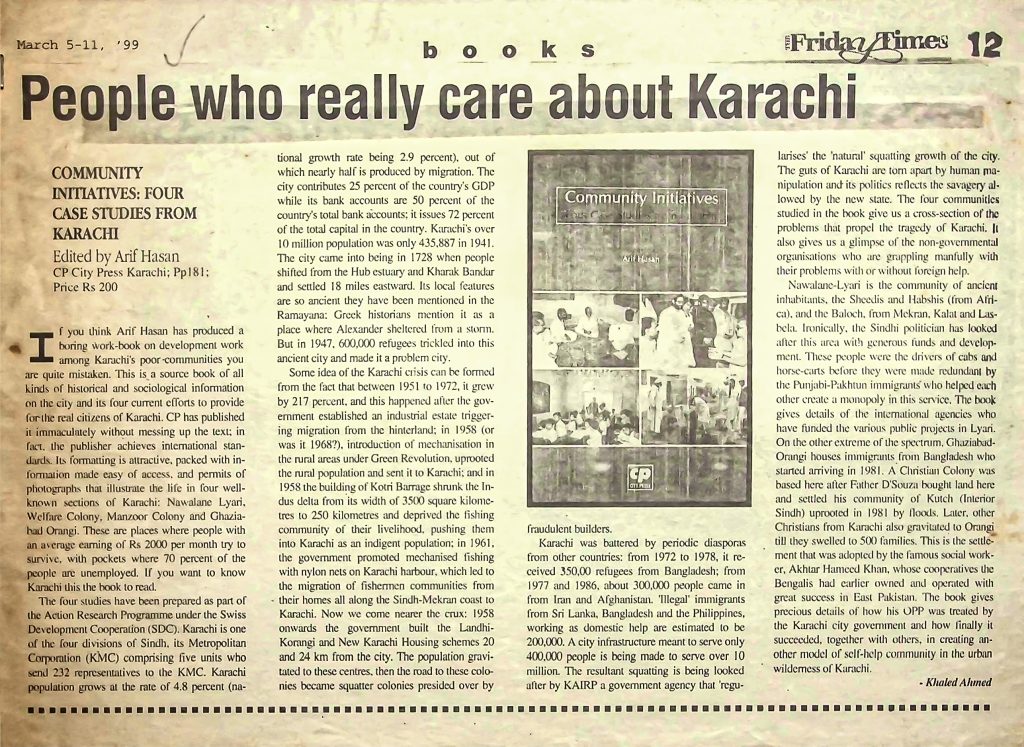
I f you think Arif Hasan has produced a boring work-book on development work among Karuchi’s poor-communities you are quite mistaken. This is a source book of all kinds of historical and sociological information on the city and its four current efforts to provide for the real citizens of Karachi. CP has published it immaculately without messing up the text, in fact, the publisher achieves international stan-dards. Its formatting is attractive, packed with in-formation made easy of access, and permits of photographs that illustrate the life in four well-known sections of Karachi: Nawalane Lyari, Welfare Colony, Manzoor Colony and Ghazia-bad Orangi. These are places where people with an average earning of Rs 2000 per month try to survive, with pockets where 70 percent of the people are unemployed. If you want to know Karachi this the book to read.
The four studies have been prepared as part of the Action Research Programme under the Swiss Development Cooperation (SDC). Karachi is one of the four divisions of Sindh, its Metropolitan Corporation (KMC) comprising five units who send 232 representatives to the KMC. Karachi population grows at the rate of 4.8 percent (na-
tional growth rate being 2.9 percent), out of which nearly half is produced by migration. The city contributes 25 percent of the country’s GDP while its bank accounts are 50 percent of the country’s total bank accounts; it issues 72 percent of the total capital in the country. Karachi’s over 10 million population was only 435,887 in 1941. The city came into being in 1728 when people shifted from the Hub estuary and Kharak Bandar and settled 18 miles eastward. Its local features are so ancient they have been mentioned in the Ramayana: Greek historians mention it as a place where Alexander sheltered from a storm, But in 1947, 600,000 refugees trickled into this ancient city and made it a problem city.
Some idea of the Karachi crisis can be formed from the fact that between 1951 to 1972, it grew by 217 percent, and this happened after the gov ernment established an industrial estate trigger-ing migration from the hinterland; in 1958 (or was it 1968?), introduction of mechanisation in the rural areas under Green Revolution, uprooted the rural population and sent it to Karachi: and in 1958 the building of Kotri Barrage shrunk the In-dus delta from its width of 3500 square kilome tres to 250 kilometres and deprived the fishing community of their livelihood, pushing them into Karachi as an indigent population; in 1961. the government promoted mechanised fishing with nylon nets on Karachi harbour, which led to the migration of fishermen communities from their homes all along the Sindh-Mekran coast to Karachi. Now we come nearer the crux: 1958 onwards the government built the Landhi-Korangi and New Karachi Housing schemes 20 and 24 km from the city. The population gravi-tated to these centres, then the road to these colo-nies became squatter colonies presided over by
Community Initiatives
fraudulent builders.
Karachi was battered by periodic diasporas from other countries: from 1972 to 1978, it re-ceived 350,00 refugees from Bangladesh; from 1977 and 1986, about 300,000 people came in from Iran and Afghanistan. ‘Illegal immigrants from Sri Lanka, Bangladesh and the Philippines, working as domestic help are estimated to be 200,000. A city infrastructure meant to serve only 400.000 people is being made to serve over 10 million. The resultant squatting is being looked after by KAIRP a government agency that ‘regu-
larises’ the ‘natural’ squatting growth of the city. The guts of Karachi are torn apart by human ma-nipulation and its politics reflects the savagery al lowed by the new state. The four communities studied in the book give us a cross-section of the problems that propel the tragedy of Karachi. It also gives us a glimpse of the non-governmental organisations who are grappling manfully with their problems with or without foreign help.
Nawalane-Lyari is the community of ancient inhabitants, the Sheedis and Habshis (from Afri-ca), and the Baloch, from Mekran, Kalat and Las bela Ironically, the Sindhi politician has looked after this area with generous funds and develop-ment. These people were the drivers of cabs and horse-carts before they were made redundant by the Punjabi-Pakhtun immigrants who helped each other create a monopoly in this service. The book gives details of the international agencies who have funded the various public projects in Lyari. On the other extreme of the spectrum, Ghaziabad-Orangi houses immigrants from Bangladesh who started arriving in 1981. A Christian Colony was based here after Father D’Souza bought land here and settled his community of Kutch (Interior Sindh) uprooted in 1981 by floods. Later, other Christians from Karachi also gravitated to Orangi till they swelled to 500 families. This is the settle ment that was adopted by the famous social work-er. Akhtar Hameed Khan, whose cooperatives the Bengalis had earlier owned and operated with great success in East Pakistan. The book gives precious details of how his OPP was treated by the Karachi city government and how finally it succeeded, together with others, in creating an-other model of self-help community in the urban wilderness of Karachi.
– Khaled Ahmed
(051) Community Initiatives: Four Case Studies From Karachi Review