April 9-15, 99
books
Friday Times
12
Forced evictions and housing development in Karachi
FORCED EVICTIONS AND HOUSING RIGHTS ABUSES IN ASIA (Second Report 1996-97)
Edited by Kenneth
Fernandes
CP City Press Karachi: Pp171
E viction Asia Watch is funded by Neth-erlands Ministry of Foreign Affairs, ACHR. and MISEREOR of Germany. It publishes reports on how the poor are evicted and their properties destroyed all over Asia in the name of development. The estimate is that nearly a million people lose their homes in the region. The book under review is the second re-port on evictions by Eviction Asia Watch. The editor Kenneth Fernandes is introduced by Mr Arif Hasan as someone with rich experience in low-income informal settlements over 15 years and has taught at Karachi’s St Patrick’s School. He also worked for Caritas Pakistan for three years, and is currently in Cambodia.
The Report covers the Asian region and see-tion on Karachi has been contributed by Mo-hammad Younis and Farooq Zahid of Urban
Resource Centre, Karachi. Pakistan has 19.54 million houses according a 1991 survey and there are 6.55 persons living in each house on average, almost equal in rural and urban areas, This relates to the benchmark population of 128 million as estimated in 1995, the national growth rate being 2.9 percent. The urban popu-lation has grown from 28 percent in 1981 to 34 percent in 1995, at the rate of 4.3 percent, and is expected to become 82 million in 2010. San-itation and water supply in the Pakistani houses is abysmal: only 30 percent houses have sanita-tion, while 90 million people are without any kind of sanitation. Fully 49 million people have no access to potable water, and in the ur-ban areas 40 percent of the households or 18 million people have no sanitation, 7 million have no piped water.
In 1947 Karachi had only half a million peo-ple; in 1996 the estimate is 10 million. The city has spread from 83 sq km to 3,500 sq km. It yields 40 percent of tax revenue and 35 percent of the country’s employment. It produces hous-ing units at the rate of 26,000 per year, the rest being contributed by squatter settlements and what are called katchi abadis. Since there are no system of land delivery and credit facilities for house builders, people usually go into katchi abadis run by land mafias backed by corrupt state bureaucracy. Once the houses are
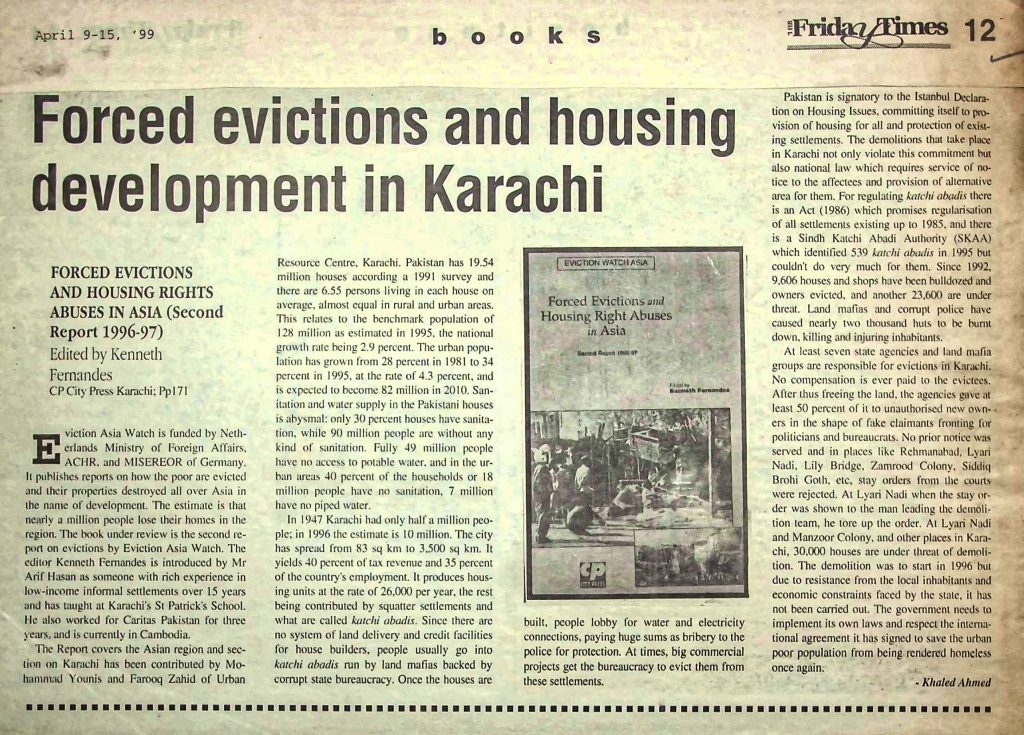
EVICTION WATCH ASIA
Forced Evictions and Housing Right Abuses in Asia
built, people lobby for water and electricity connections, paying huge sums as bribery to the police for protection. At times, big commercial projects get the bureaucracy to evict them from these settlements.
Pakistan is signatory to the Istanbul Declara tion on Housing Issues, committing itself to pro-vision of housing for all and protection of exist ing settlements. The demolitions that take place in Karachi not only violate this commitment but also national law which requires service of no-tice to the affectees and provision of alternative area for them. For regulating katchi abadis there is an Act (1986) which promises regularisation of all settlements existing up to 1985, and there is a Sindh Katchi Abadi Authority (SKAA) which identified 539 katchi abadis in 1995 but couldn’t do very much for them. Since 1992. 9,606 houses and shops have been bulldozed and owners evicted, and another 23,600 are under threat. Land mafias and corrupt police have caused nearly two thousand huts to be burnt down, killing and injuring inhabitants.
At least seven state agencies and land mafia groups are responsible for evictions in Karachi, No compensation is ever paid to the evictees. After thus freeing the land, the agencies gave at least 50 percent of it to unauthorised new own-ers in the shape of fake claimants fronting for politicians and bureaucrats. No prior notice was served and in places like Rehmanabad, Lyari Nadi, Lily Bridge, Zamrood Colony, Siddiq Brohi Goth, etc, stay orders from the courts were rejected. At Lyari Nadi when the stay or-der was shown to the man leading the demoli-tion team, he tore up the order. At Lyari Nadi and Manzoor Colony, and other places in Kara-chi, 30,000 houses are under threat of demoli-tion. The demolition was to start in 1996 but due to resistance from the local inhabitants and economic constraints faced by the state, it has not been carried out. The government needs to implement its own laws and respect the interna tional agreement it has signed to save the urban poor population from being rendered homeless once again.
-Khaled Ahmed
(057) Forced Evictions And Housing Right Abuses In Asia Review