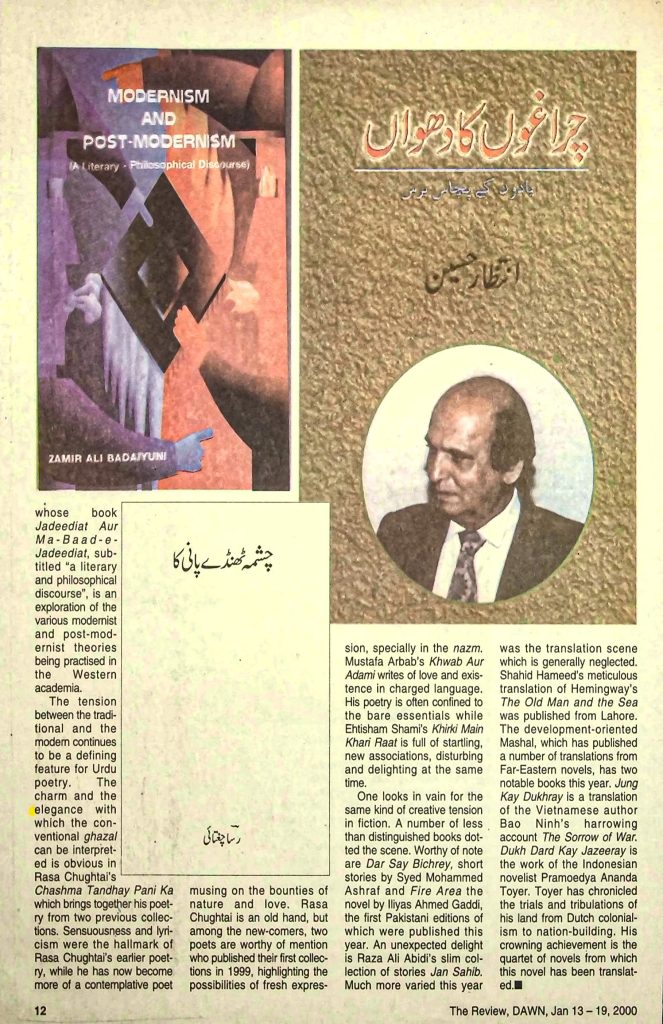
ZAMIR ALI BADAJYUNI
whose book Jadeediat Aur Ma-Baad-e-Jadeediat, sub-titled “a literary and philosophical discourse”, is an exploration of the various modernist and post-mod-ernist theories being practised in the Western academia.
The tension
between the tradi-tional and the modern continues to be a defining feature for Urdu poetry. The charm and the elegance with which the con-ventional ghazal can be interpret-ed is obvious in Rasa Chughtai’s Chashma Tandhay Pani Ka which brings together his poet-ry from two previous collec-tions. Sensuousness and lyri-cism were the hallmark of Rasa Chughtai’s earlier poet-ry, while he has now become more of a contemplative poet
چشمہ ٹھنڈے پانی کا
12
رسا چغتائی
musing on the bounties of nature and love. Rasa Chughtai is an old hand, but among the new-comers, two poets are worthy of mention who published their first collec-tions in 1999, highlighting the possibilities of fresh expres
sion, specially in the nazm. Mustafa Arbab’s Khwab Aur Adami writes of love and exis tence in charged language. His poetry is often confined to the bare essentials while Ehtisham Shami’s Khirki Main Khari Raat is full of startling, new associations, disturbing and delighting at the same time.
One looks in vain for the same kind of creative tension in fiction. A number of less than distinguished books dot-ted the scene. Worthy of note are Dar Say Bichrey, short stories by Syed Mohammed Ashraf and Fire Area the novel by Iliyas Ahmed Gaddi, the first Pakistani editions of which were published this year. An unexpected delight is Raza Ali Abidi’s slim col lection of stories Jan Sahib. Much more varied this year
was the translation scene which is generally neglected. Shahid Hameed’s meticulous translation of Hemingway’s The Old Man and the Sea was published from Lahore. The development-oriented Mashal, which has published a number of translations from Far-Eastern novels, has two notable books this year. Jung Kay Dukhray is a translation of the Vietnamese author Bao Ninh’s harrowing account The Sorrow of War. Dukh Dard Kay Jazeeray is the work of the Indonesian novelist Pramoedya Ananda Toyer. Toyer has chronicled the trials and tribulations of his land from Dutch colonial-ism to nation-building. His crowning achievement is the quartet of novels from which this novel has been translat-ed.
The Review, DAWN, Jan 13-19, 2000
image66