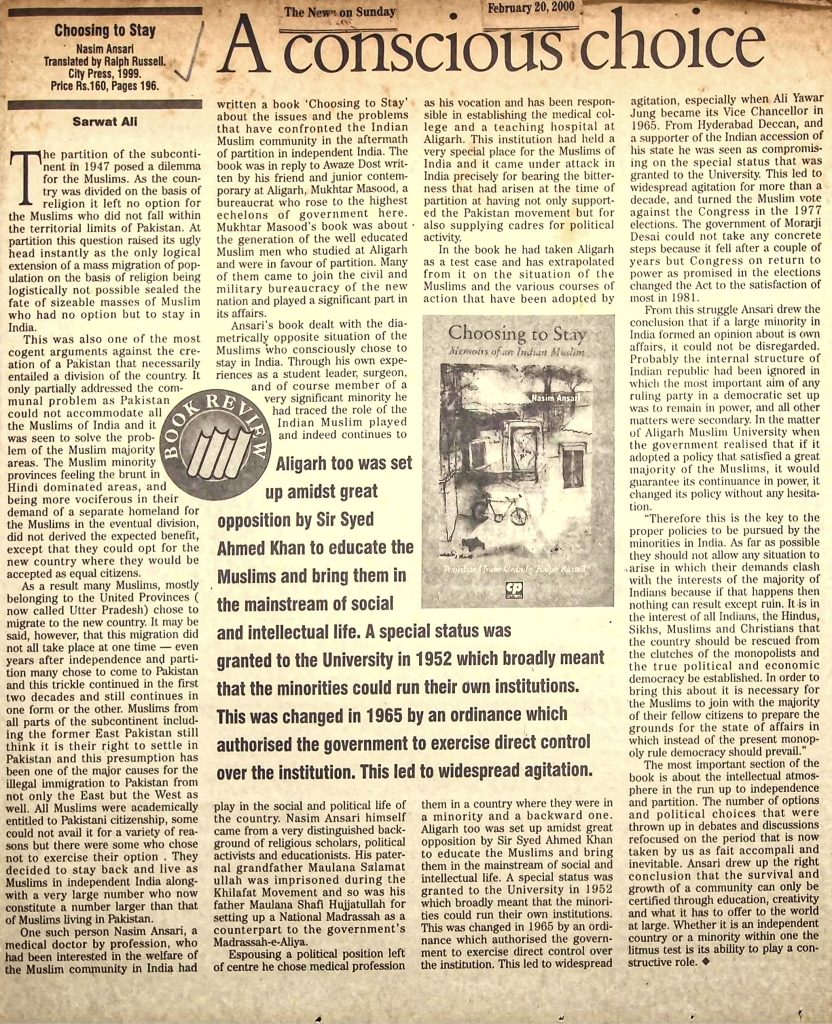
Choosing to Stay
Nasim Ansari Translated by Ralph Russell.
City Press, 1999.
Price Rs.160, Pages 196.
Sarwat Ali
T The partition of the subconti nent in 1947 posed a dilemma for the Muslims. As the coun-try was divided on the basis of religion it left no option for the Muslims who did not fall within the territorial limits of Pakistan. At partition this question raised its ugly head instantly as the only logical extension of a mass migration of pop-ulation on the basis of religion being logistically not possible sealed the fate of sizeable masses of Muslim who had no option but to stay in India.
This was also one of the most cogent arguments against the cre ation of a Pakistan that necessarily entailed a division of the country. It only partially addressed the com-munal problem as Pakistan was seen to solve the prob-lem of the Muslim majority areas. The Muslim minority provinces feeling the brunt in Hindi dominated areas, and being more vociferous in their demand of a separate homeland for the Muslims in the eventual division, did not derived the expected benefit, except that they could opt for the new country where they would be accepted as equal citizens.
could not accommodate all K the Muslims of India and itK
As a result many Muslims, mostly belonging to the United Provinces ( now called Utter Pradesh) chose to migrate to the new country. It may be said, however, that this migration did not all take place at one time even years after independence and parti tion many chose to come to Pakistan and this trickle continued in the first two decades and still continues in one form or the other. Muslims from all parts of the subcontinent includ-ing the former East Pakistan still think it is their right to settle in Pakistan and this presumption has been one of the major causes for the illegal immigration to Pakistan from not only the East but the West as well. All Muslims were academically entitled to Pakistani citizenship, some could not avail it for a variety of rea sons but there were some who chose not to exercise their option. They decided to stay back and live as Muslims in independent India along with a very large number who now constitute a number larger than that of Muslims living in Pakistan.
One such person Nasim Ansari, a medical doctor by profession, who had been interested in the welfare of the Muslim community in India had
The News on Sunday
February 20, 2000
A conscious choice
written a book ‘Choosing to Stay’ about the issues and the problems that have confronted the Indian Muslim community in the aftermath of partition in independent India. The book was in reply to Awaze Dost writ ten by his friend and junior contem porary at Aligarh, Mukhtar Masood, a bureaucrat who rose to the highest echelons of government here. Mukhtar Masood’s book was about the generation of the well educated Muslim men who studied at Aligarh and were in favour of partition. Many of them came to join the civil and military bureaucracy of the new nation and played a significant part in its affairs.
Ansari’s book dealt with the dia-metrically opposite situation of the Muslims who consciously chose to stay in India. Through his own expe riences as a student leader, surgeon, and of course member of a very significant minority he had traced the role of the Indian Muslim played and indeed continues to REVI
Aligarh too was set up amidst great opposition by Sir Syed Ahmed Khan to educate the Muslims and bring them in the mainstream of social and intellectual life. A special status was granted to the University in 1952 which broadly meant that the minorities could run their own institutions. This was changed in 1965 by an ordinance which authorised the government to exercise direct control over the institution. This led to widespread agitation.
play in the social and political life of the country. Nasim Ansari himself came from a very distinguished back-ground of religious scholars, political activists and educationists. His pater nal grandfather Maulana Salamat ullah was imprisoned during the Khilafat Movement and so was his father Maulana Shafi Hujjatullah for setting up a National Madrassah as a counterpart to the government’s
Madrassah-e-Aliya. Espousing a political position left of centre he chose medical profession
as his vocation and has been respon-sible in establishing the medical col-lege and a teaching hospital at Aligarh. This institution had held a very special place for the Muslims of India and it came under attack in India precisely for bearing the bitter ness that had arisen at the time of partition at having not only support ed the Pakistan movement but for also supplying cadres for political
activity. In the book he had taken Aligarh as a test case and has extrapolated from it on the situation of the Muslims and the various courses of action that have been adopted by
Choosing to Stay Niemoirs of an Indian Muslim
CP
them in a country where they were in a minority and a backward one. Aligarh too was set up amidst great opposition by Sir Syed Ahmed Khan to educate the Muslims and bring them in the mainstream of social and intellectual life. A special status was granted to the University in 1952 which broadly meant that the minori ties could run their own institutions. This was changed in 1965 by an ordi nance which authorised the govern ment to exercise direct control over the institution. This led to widespread
agitation, especially when Ali Yawar Jung became its Vice Chancellor in 1965. From Hyderabad Deccan, and a supporter of the Indian accession of his state he was seen as compromis-ing on the special status that was granted to the University. This led to widespread agitation for more than a decade, and turned the Muslim vote against the Congress in the 1977 elections. The government of Morarji Desai could not take any concrete steps because it fell after a couple of years but Congress on return to power as promised in the elections. changed the Act to the satisfaction of most in 1981.
From this struggle Ansari drew the conclusion that if a large minority in India formed an opinion about is own affairs, it could not be disregarded. Probably the internal structure of Indian republic had been ignored in which the most important aim of any ruling party in a democratic set up was to remain in power, and all other matters were secondary. In the matter of Aligarh Muslim University when the government realised that if it adopted a policy that satisfied a great majority of the Muslims, it would guarantee its continuance in power, it changed its policy without any hesita-tion.
“Therefore this is the key to the proper policies to be pursued by the minorities in India. As far as possible they should not allow any situation to arise in which their demands clash with the interests of the majority of Indians because if that happens then. nothing can result except ruin. It is in the interest of all Indians, the Hindus, Sikhs, Muslims and Christians that the country should be rescued from the clutches of the monopolists and the true political and economic democracy be established. In order to bring this about it is necessary for the Muslims to join with the majority of their fellow citizens to prepare the grounds for the state of affairs in which instead of the present monop-oly rule democracy should prevail.
The most important section of the book is about the intellectual atmos-phere in the run up to independence and partition. The number of options and political choices that were thrown up in debates and discussions refocused on the period that is now taken by us as fait accompali and inevitable. Ansari drew up the right conclusion that the survival and growth of a community can only be certified through education, creativity and what it has to offer to the world at large. Whether it is an independent country or a minority within one the litmus test is its ability to play a con-structive role.
(070) Choosing to Stay Review