4 ARTICLES
BOOKS & AUTHORS, DAWN, October 16, 2001
Whither this Urdu chauvinism?
WEBSITE REVIEW
By Ajmal Kamal
A BOUT eight years ago, while I was compiling a special issue of the literary quarterly Aaj featuring a selection of modean Hindi short fictiort, translated or, transliterated into Urdu, 1 was struck by the fact that only about five per cent words in the selected Hindi stories required to be replaced in the Urdu version. I needed to know how the scholars of Urdu language define Urdu so that it could be distinguished from Hindi.
In my naivete I thought that since the the question of Urdu/Hindi had been so hotly contested in the northern part of India for more than a cen tury, there must be enough documentation on the subject to guide a novice like me. I was proved wrong soon enough. In my search for answers to many questions I discovered, instead, some peculiarities that characterize the writings on the subject. I found it intriguing that Urdu, unlike most other languages of the subcontinent, is not just a language spoken by a community of people, but much more than that. It is a space where political battles are fought. It is a cause, almost a religion, in the sense that it needs a mythology more than a history. is not
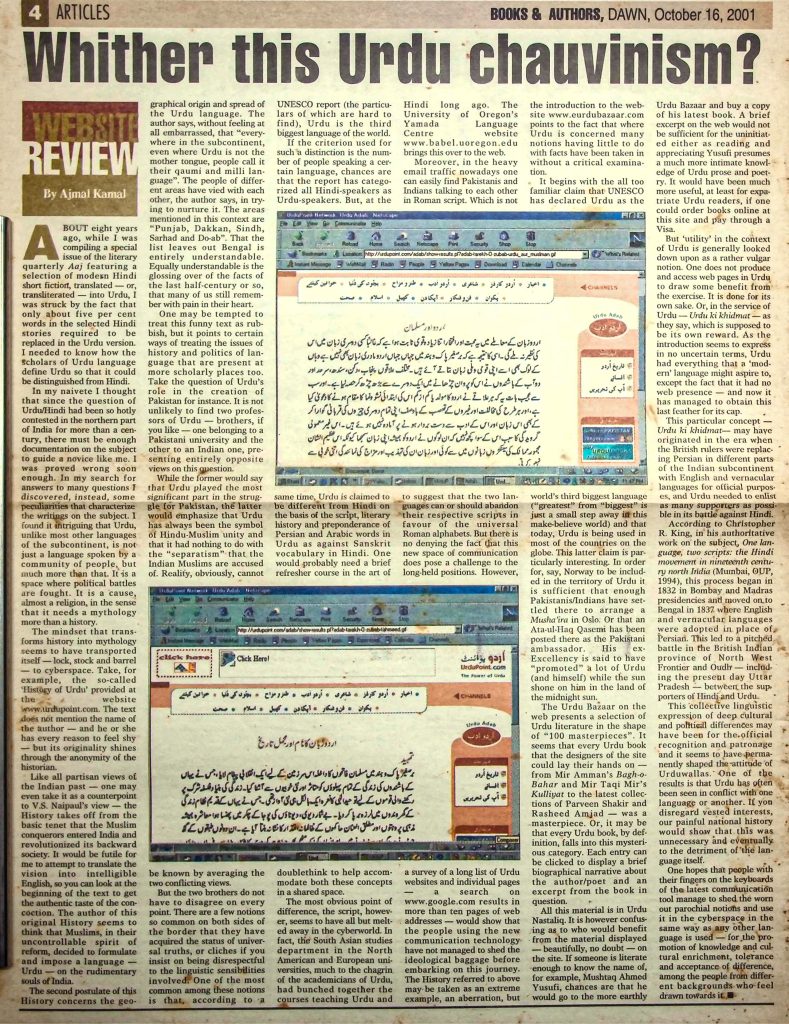
The mindset that trans-forms history into mythology seems to have transported itself-lock, stock and barrel in cyberspace. Take, for example, the so-called “listingy of Urdu’ provided at website pew.urdupoint.com. The text does not mention the name of the author and he or she has every reason to feel shy but its originality shines through the anonymnuty of the historian
Like all partisan views of the Indian past one may even take it as a counterpoim to V.S. Naipaul’s view the History takes off from the basic tenet that the Muslim conquerors entered India and revolutionized its backward sociery. It would be futile for me to attempt to translate the vision into intelligible English, so you can look at the beginning of the text to get the authentic taste of the con-coction. The author of this original History seems to think that Muslims, in their uncontrollable spirit of reform, decided to formulate and impose a language Urdu on the rudimentary
souls of India. The secund postulate of this History concerns the geo
graphical origin and spread of the Urdu language. The author says, without feeling at all embarrassed, that “every where in the subcontinent, even where Urdu is not the mother tongue, people call it their qaumi and milli lan guage”. The people of differ ent areas have vied with each other, the author author says, says, in in try ing to nurture it. The areas mentioned in this context are “Punjab, Dakkan, Sindh, Sarhad and Do-ab”. That the list leaves out Bengal is entirely un understandable. Equally understandable is the glossing over of the facts of the last half-century or so, that many of us still remem ber with pain in their heart.
One may be tempted to treat this funny text as rub bish, but it points to certain ways of treating the issues of history and politics of lan guage that are present at more scholarly places too. Take the question of Urdu’s role in the creation of Pakistan for instance. It is not unlikely to find two profes-sors of Urdu brothers, if you like one belonging to a Pakistani university and the other to an Indian lian or one, pre senting entirely opposite
views on this question While the former would say that Urdu played the most significant part in the strug gle for Pakistan, the latter would emphasize that Urdu has always been the symbol of Hindu Muslim unity and that it had nothing to do with the “separatism” that the Indian Muslims are accused of. Reality, obviously, cannot
UNESCO report (the particu lars of which are hard to find), Urdu is the third biggest language of the world. If the criterion used for such a distinction is the num ber of people speaking a tain language, chances are that the report has catego-rized all Hindi-speakers as Urdu-speakers. But, at the
Hindi long ago. The University of Oregon’s Yamada Language Centre website www.babel.uoregon.edu brings this over to the web. Moreover, in the heavy email traffic nowadays one can easily find Pakistanis and Indians talking to each other
اخبار و آردو کارنر – شاعری ، اردو است و طرو مزاج و متون کی کیا ، جوائین کیتے
یگران – فروشکار – ایکادن و کمیل و اسلام و صحت
اردو اور مسلمان
اردو زبان کے معاملے میں یہ محبت اور افکار اتنا زیادہ قومی ثابت ہوا ہے کہ نائی کسی دوسری زبان میں اس کی نظیر نہ ملے گی۔ اس کا نتیجہ ہے کہ بر صغیر پاک وہند میں جہاں جہاں مردہ مادری زبان بھی نہیں ہے جہاں کے لوگ بھی اسے اچھی قومی ولی زبان بتاتے آئے ہیں۔ مختلف علاقوں پنجاب رکن شد و سرحد اور رو اب کے باشندوں نے اس کو پروان چڑ ھانے میں ایک دوسرے سے دوچ دے کر حصہ لیا ہے۔ اور سب سے عجیب بات ہے کہ ہر علاقے نے اردو کا سولہ یا کم از کم اس کی ابتدائی نشو ونما کا مقام ہونے کا دھونی کیا ہے، اور ہر طرح کی مخالفت اور غیروں کے نسب کے ہار ملک اپنی تمام دوسری مجھے وں کی قربانی گوارا کر کے بھی اس زبان اور اس کے ادب سے دست بردار ہونے پہ آمادہ نہیں ہوتے ہیں۔ اس غیر معمولی گروہ کی کا سب اس کے سوا کچھ نہیں کہ ان لوگوں نے اردو کو ہمیشہ اپنی زبان سمجھا کیو نکہ اس عظیم الشان مجموعہ ممالک کی کروں زبانوں میں سے کوئی اور زبان ان کی قبلہ جیب اور مزاج کی تما زندگی اپنی خولی سے
same time, Urdu is claimed to be different from Hindi on the basis of the script, literary history and preponderance of Persian and Arabic words in Urdu as against Sanskrit vocabulary in ary in Hindi. One would probably need a brief refresher course in the art of
to suggest that the two lan guages can or should aban their respective scripts in an or should abandon favour of the universal Roman alphabets. But there is no denying the fact that this new space of communication the does pose a challenge to the long-held positions. However,
Untafont.com اردو پوانت
ه اخبار ، اردو کاران – شاعری ، اردو ادب و خر و مراج – مجلوں کی دنیا ، جوائن کیلیے
یگران و فن و شکار و ایکادن و کمیل و اسلام و صحت
تحمید
اردو زبان کا نام اور مجمل تاریخ
یر پاک و ہند میں مسلمان خاتوں کا داخلہ اس سر زمین کے لیے ایک انقلابی پیام لایا، جس نے یہاں کے باشندوں کی زندگی کے تمام پہلوؤں کو جاڑ اور کی عربوں سے آشنا کیا۔ زندگی کی تیار نہ شرک ہے رکھنے والی قوموں کے لیے تو ممانی کا اخرہ ایک اٹل ہی کی آوا تھی۔ جس نے یہاں کے قدیم کلام زندگی کے گھروندوں میں ارز در پا کر دیا۔ بے شمار دیوی دیوتاؤں کی ہر جا کے چکر میں پھنسا ہوا معاشرہ ہمیشہ ندہی پر دلتوں اور مطلق الذ ان حاکموں کے مخالفات اللہ ان کا نشانہ بنتا آیا ہے۔ ان دونوں باتوں کے گے
be known by averaging the two conflicting views.
But the two brothers do not have to disagree on every point. There are a few notions so common on both sides of the border that they have acquired the status of univer sal truths, or cliches if you insist on being disrespectful to the linguistic tic sensibilities involved One of the most common among these notions is that, according to a
doublethink to help accom modate both these concepts in a shared space.
The most obvious point of difference, the script, howev er, seems to have all but melt yberworld. In ed away in the cyberworld. I fact, the South Asian studies department in the North American and European uni versities, much to the chagrin of the academicians of Urdu, had bunched together the courses teaching Urdu and
CHANABLE
تاریخ اردو کا آپ کی تحریری
a survey of a long list of Urdu websites and individual pages search a on
www.google.com results in more than ten pages of web addresses would show that the people using the new communication technology have not managed to shed the ideological baggage before embarking on this journey, The History referred to above may be taken as an extreme example, an aberration, but
N
the introduction to the web site www.eurdubazaar.com points to the fact that where Urdu is concerned many notions having little to do with facts have been taken in without a critical examina
tion It begins with the all too familiar claim that UNESCO has declared Urdu as the
in Roman script. Which is not
Urdu Bazaar and buy a copy of his latest book. A brief excerpt on the web would not be sufficient for the uninitiat ed either as reading and appreciating Yusufi presumes a much more intimate knowl edge of Urdu prose and poet ry. It would have been much more useful, at least for expa triate Urdu readers, if one could order books online at this site and pay through a Visa.
But ‘utility’ in the comest of Urdu is generally looked down upon as a rather vulgar notion. One does not produce and access web pages in Urdu to draw some benefit from the exercise. It is done for its own sake. Or, in the service of Urdu Urdu ki khidmat as they say, which is supposed to be its own reward. As the introduction seems to express in no uncertain terms, Urdu had everything that a ‘mod ern’ language might aspire to, except the fact that it had no web presence and now it has managed to obtain this last feather for its cap
تاريخ أردو المسائل آپ کی تحریری
This particular concept-Urdu ki khidmat may have originated in the era when the British rulers were replac ing Persian in different parts E of the Indian subcontinent with English and vernacular languages for official purpos es, and Urdu needed to enlist many supporters as possi ble in its battle against Hindi. as
world’s third biggest language (greatest” reatest” from “biggest” is junt a small step away if this make-believe world) and that today, Urdu is being used in most of the countries on the globe. This latter claim is par ticularly interesting. In order interesting, In order for, say, Norway to be includ ed in the territory of Urdu it is sufficient that enough Pakistanis/Indians have set tled there there to arrange a Mushaira in Oslo: Or that an Ata-ul-Haq Qasemi has been posted there as the Pakistani ambassador. His ex Excellency is said to have “promoted” a lot of Urdu (and himself) while the sun shone on him in the land of the midnight sun.
According to Christopher R. King, in’ his authoritative work on the subject, One lan guage, two scripts: the Hindi movement in nineteenth centu ry north Bidia (Mumbai, OUP, 1994), this process began in 1832 in Bombay and Madras presidencies antf moved on to Bengal in 1837 where English and vernacular languages were adopted in place of Persian. This led to a pitched. battle in the British Indian province of North West Frontier and Oudir-includ ing the present day Uttar Pradesh between the sup porters of Hindi and Urdu
The Urdu Bazaar on the web presents a selection of Urdu literature in the shape of “100 masterpieces”. It seems that every Urdu du book book that the designers of the site could lay their hands on from Mir Amman’s Bagh-o-Bahar and Mir Taqi Mir’s Kulliyar to the latest collec tions of Parveen Shakir and Rasheed Amjad was a masterpiece. Or, it may be that every Urdu book, by def inition, falls into this mysteri ous category. Each entry can be clicked to display a brief biographical narrative about the author/poet and an excerpt from the book ook in question.
All this material is in Urdu Nastaliq. It is however confus ing as to who would benefit from the material displayed beautifully, no doubt on the site. If someone is literate enough to know the name of, for example, Mushtaq Ahmed Yusufi, chances are that he would go to the more earthly
This collective linguistic expression of deep cultural and politicall differences may have been for the official recognition and and patronage and it seems to have perma nently shaped the attitude of Urduwallas. One of the results is that Urdu has often been seen in conflict with one language or another. If you disregard vested interests, our painful national history would show that this was unnecessary and eventually to the detriment of the lan guage itself.
One hopes that people with their fingers on the keyboards of the latest communication tool manage to shed the worn out parochial notions and use it in the cyberspace in the same way as any other lan guage is used for the pro motion of knowledge and cul tural enrichment, tolerance and acceptance of difference, among the people from differ ent hackgrounds who feel drawn towards it
image77