
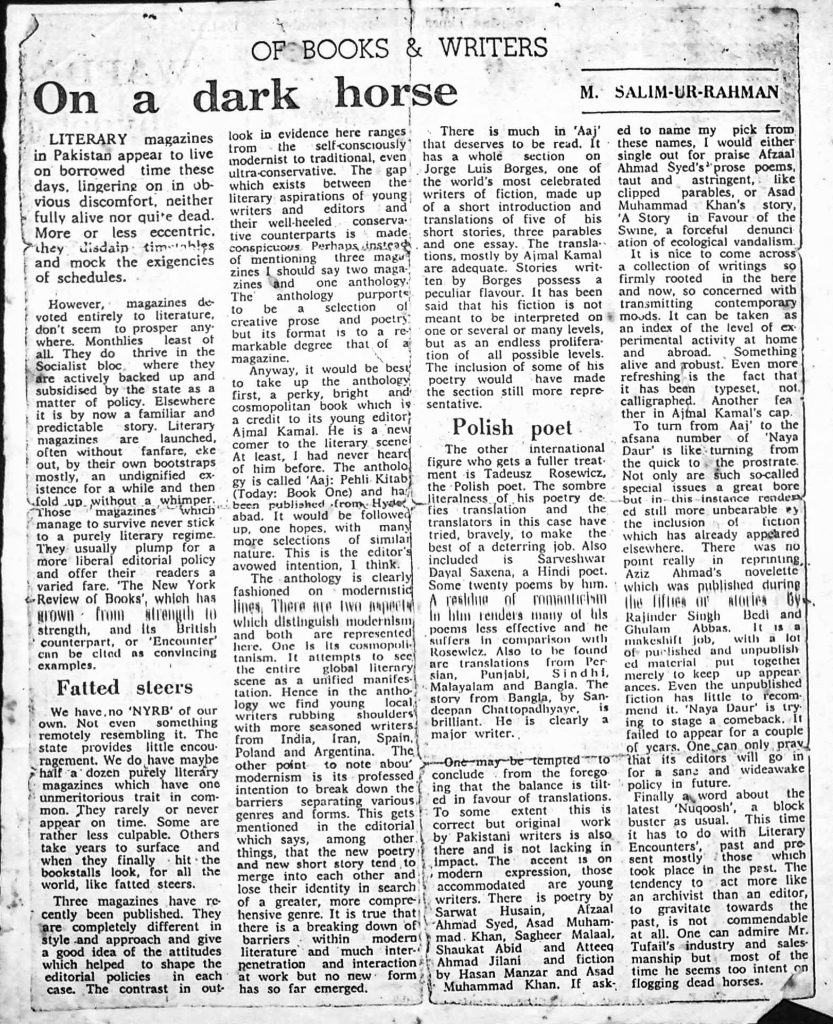
LITERARY magazines in Pakistan appear to live on borrowed time these days. Epigones on in obvious discomfort, neither fully alive nor quite dead. More or less eccentric, they leaden direly times and mock the exigencies of schedules. However, magazines devoted entirely to literature, don’t seem to prosper any where. Modest, least of all. They do thrive in the Socialist bloc where they are actively backed up and subsidised by the state as a matter of policy. Elsewhere, it is a non familiar and medium-size affair. Literary magazines are launched, often without fanfare, exist by their own compulsions mostly on sufferance and then fold up without a whimper. Issuance is almost a contrivance to manage to survive never stick to a purely literary regime. They usually plump a more liberal editorial policy and offer their readers a varied fare. The New York Review of Books, which has grown from strength to strength, and its British counterpart or ‘Encounter’, are cases of convincing examples. Fatted steers We have no ‘NYRB’ of our own, nor even something remotely resembling it. The state provides little encouragement. We do have maybe half a dozen purely literary magazines which have an unmeritorious trait in common: They rarely or never appear on time. Some are rather less capable. Others take years to surface and when they finally do, they look for all the world, like fatted steers. Three magazines have recently been published. They are completely different in style and approach and give a good idea of the attitudes which helped to shape the editorial policies in each case. The contrast in outlook in evidence here ranges from the self-consciously traditionalist to traditional, even ultra-conservative. The gap which exists between the literary aspirations of young writers and editors and their well-heeled conservative counterparts is simply conspicuous. Perhaps, instead of mentioning three magazines I should say two magazines and one anthology. The anthology purports to be ‘a selection of creative prose and poetry’ but its layout is of a remarkable degree that it is welcome. Anyway, it would be best to take up the anthology first, a perky, bright and composition to which is a credit of its young editor, Ajmal Kamal. He is a new comer in the literary scene, at least I had never heard of him before. The anthology is called Aaj; Pehli Kitab (Today; Book One) and has been published from Hyderabad. It would be followed by one book with many more selections of similar nature. This is the editor’s avowed intention, I think. The anthology is clearly fashioned on modernistic lines. There are two aspects which distinguish modernism and both are represented here. One is a cosmopolitanism. It attempts to see the entire national literary scene as a unified manifestation. Hence in the anthology he has young, creative writers rubbing shoulders with more seasoned writers from Sind, Iran, Spain, Poland and Argentina. The other point to note about modernism is its professed intention to break down the barriers separating various genres and forms. This gets mentioned, or he declares, which says, among other things, that the new poetry and the short story tend to merge into each other and lose their identity in search of a greater, more comprehensive genre. It is true that there is a breaking down of ‘geners’ within modern literature, and much inter penetration and interaction of work but no new ‘form’ has so far emerged. There is much in ‘Aaj’ that deserves to be read, if only a whole ‘section’ on Jorge Luis Borges, one of the world’s most celebrated writers of fiction, made up of a short introduction and translations of five of his short stories, five parables and one essay. The translations, mostly by Ajmal Kamal, are adequate. Stories written by Borges possess a security fitting, it has been said, that his fiction is not meant to be interpreted on one or several or many levels, but as an endless projection, not at all possible levels. The inclusion of some of his poetry would have made the section still more representative. Polish poet The other international figure who gets a fuller treatment is Tadeusz Rosewicz, the Polish poet. The number lilerainess of his poetry defies translation. But the translators in this case have tried bravely to make the best of a deterring job. Also included is Sarveishwar Dayal Saxena, a Hindi poet. Some twenty poems by him. A handful of translations of Urdu rendition made of his poems less effective and he suffers in comparison with Rosewicz. Also can be found are translations from Persian, Punjabi, Sindhi, Malayalam and Bangla. The item from Bangla, by Hasan Azeezul Haq, translated by Ikram Chughtaiyya, is brilliant. He is clearly a major writer. One may be tempted to conclude from the foregoing that the balance is tilted in favour of translations. To some extent this is correct but original work by Pakistani writers is also there, and is not lacking in impact. The accent is on ‘modern’ expression. More accommodated are young writers. There is poetry by Saadat Saeed, Afzaal Ahmad, Syed Ataul Mujeeb, Jamil Khan, Sagheer Malal, Shaukat Abid and Atteeb Ahmad. Jilani and fiction by Intizar Husain and Asad Muhammad Khan. If asked to name my pick from these names, I would rather single out for praise Afzaal Ahmad, Syed Ataul Mujeeb, taut and ‘astringent’, like clipped paragraphs or something. A new ‘style’ or ‘stance’ by its own flavour in the fiction of Asad Muhammad Khan’s story, ‘A Stone… in Favour of the Owner’, focuses demands attention. A forage of ecological vandalism, a nice bit of satire across a collection of writings so finely rooted in the heritage and yet concerned with transmitting contemporary meaning, can be taken as an index of the level of experience, activity at home and abroad. Something else: freshness. Even more refreshing is the fact that it has been typeset, not calligraphed. Another feather in Ajmal Kamal’s cap. To turn from this to the afsana number of ‘Naya Daur’ is like turning from the quick to the prostrate. Not only are such ‘special’ ‘special issues’ a great bore but in this instance readers are bound to be underwhelmed by the inclusion of fiction which has already appeared elsewhere. There was no point even in reprinting, Aziz Ahmad’s ‘Nawishta’, which was published during the fifties or sixties. In Sujagjeet Singh Bedi of Ghulam Abbas. It is a mixed-up job with a lot of polished and unpublish ed material put together. Merely to keep up appearances. Even the unpublished sketch, that finds its recommended to ‘Naya Daur’ is trying to stage a comeback, it failed to appear for a couple of years. One can only hope that its editors will go in for a sane and wide-awake policy in future. Finally a word about the good, ‘Nusrat’. It’s bluster as usual. This time it has to do with ‘Literary mount-e-bank’. And ‘presently mostly those which took once in the past, the tendency to act more like an archivist than an editor’, to gravitate towards the past is not commendable. At all. One can admire Mr. Tufail’s industry and salesmanship but most of the time he seems too intent on flogging dead horses.
