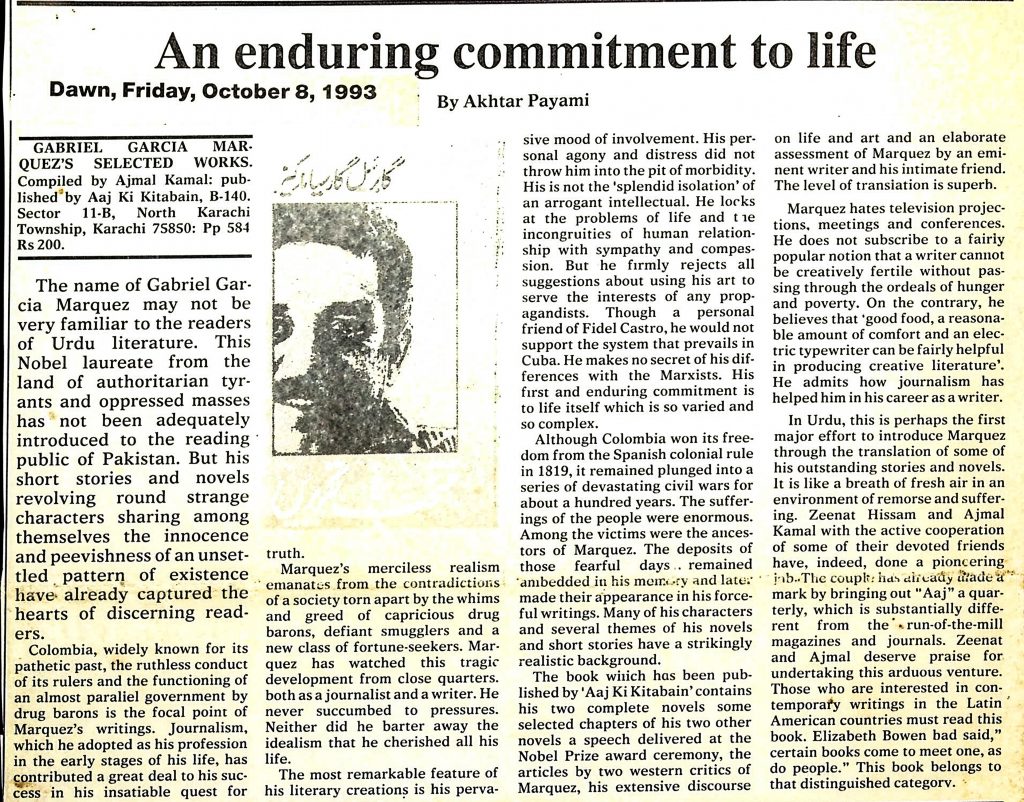
The name of Gabriel Garcia Marquez may not be very familiar to the readers of Urdu literature. This Nobel laureate from the land of authoritarian tyrants and oppressed masses has not been adequately introduced to the reading public of Pakistan. But his short stories and novels revolving round strange characters sharing among themselves the innocence and peevishness of an unsettled pattern of existence have already captured the hearts of discerning readers. Colombia, widely known for its pathetic past, the ruthless conduct of its rulers and the functioning of an almost parallel government by drug barons is the focal point of Marquez’s writings. Journalism, which he adopted as his profession in the early stages of his life, has contributed a great deal to his success in his insatiable quest for truth. Marquez’s merciless realism emanates from the contradictions of a society torn apart by the whims and greed of capricious drug barons, defiant smugglers and a new class of fortune-seekers. Marquez has watched this tragic development from close quarters, both as a journalist and a writer. He never succumbed to pressures. Neither did he barter away the idealism that he cherished all his life. The most remarkable feature of his literary creations is his pervasive mood of involvement. His personal agony and distress did not throw him into the pit of morbidity. His is not the ‘splendid isolation’ of an arrogant intellectual. He looks at the problems of life and the incongruities of human relationship with sympathy and compassion. But he firmly rejects all suggestions about using his art to serve the interests of any propagandists. Though a personal friend of Fidel Castro, he would not support the system that prevails in Cuba. He makes no secret of his differences with the Marxists. His first and enduring commitment is to life itself which is so varied and so complex. Although Colombia won its freedom from the Spanish colonial rule in 1819, it remained plunged into a series of devastating civil wars for about a hundred years. The sufferings of the people were enormous. Among the victims were the ancestors of Marquez. The deposits of those fearful days remained embedded in his memory and later made their appearance in his forceful writings. Many of his characters and several themes of his novels and short stories have a strikingly realistic background. The book which has been published by ‘Aaj Ki Kitabain’ contains his two complete novels some selected chapters of his two other novels a speech delivered at the Nobel Prize award ceremony, the articles by two western critics of Marquez, his extensive discourse on life and art and an elaborate assessment of Marquez by an eminent writer and his intimate friend. The level of translation is superb. Marquez hates television projections, meetings and conferences. He does not subscribe to a fairly popular notion that a writer cannot be creatively fertile without passing through the ordeals of hunger and poverty. On the contrary, he believes that ‘good food, a reasonable amount of comfort and an electric typewriter can be fairly helpful in producing creative literature’. He admits how journalism has helped him in his career as a writer. In Urdu, this is perhaps the first major effort to introduce Marquez through the translation of some of his outstanding stories and novels. It is like a ‘breath of fresh air’ in an environment of remorse and suffering. Zeenat Hissam and Ajmal Kamal with the active cooperation of some of their devoted friends have, indeed, done a pioneering job. The couple has already made a mark by bringing out “Aaj” a quarterly, which is substantially different from the run-of-the-mill magazines and journals. Zeenat and Ajmal deserve praise for undertaking this arduous venture. Those who are interested in contemporary writings in the Latin American countries must read this book. Elizabeth Bowen had said,” ‘certain books come to meet one, as do people.” This book belongs to that distinguished category.
(004) Gabriel Garcia Marquez – Muntakhab Tehreerain reviewed by Akhtar Payami in Dawn