
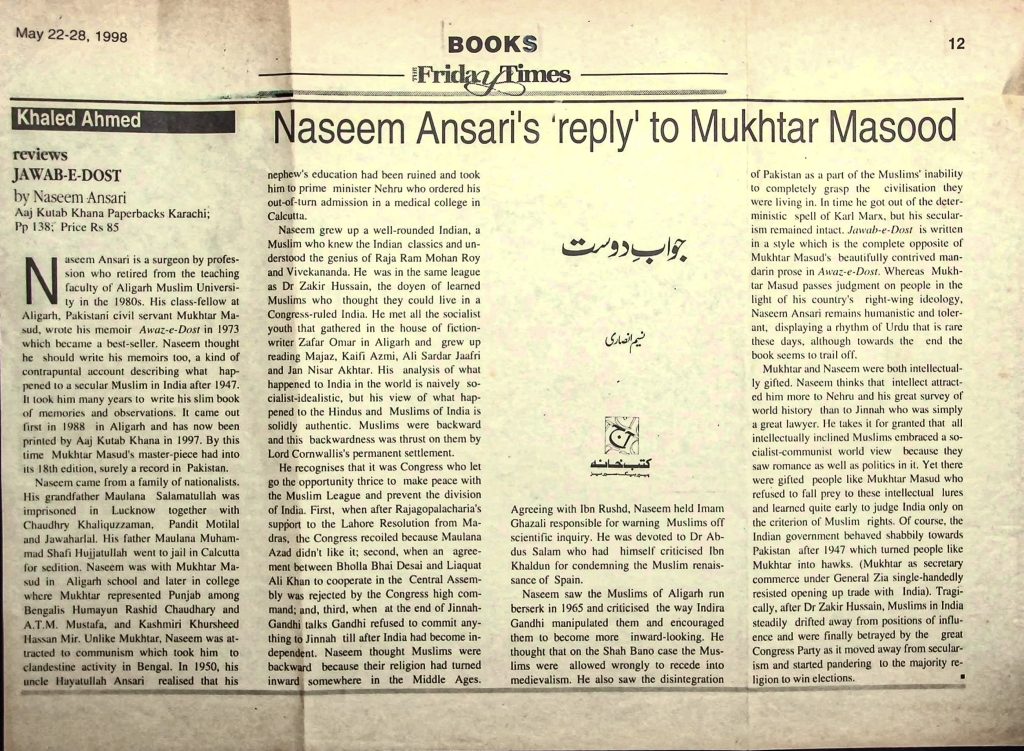
Naseem Ansari’s reply to Mukhtar Masood
Khaled Ahmed
Naseem Ansari is a surgeon by profession who retired from the teaching faculty of Aligarh Muslim University in the 1980s. His class-fellow at Aligarh, Pakistani civil servant Mukhtar Masood, wrote his memoir Awaz-e-Dost in 1973 which became a bestseller. Naseem thought he should write his memoirs too, a kind of contrapuntal account describing what happened to a secular Muslim in India after 1947. It took him many years to write his slim book of memories and observations. It came out first in 1988 in Aligarh and has now been printed by Aaj Kutab Khana in 1997. By this time Mukhtar Masood’s masterpiece had run into its 18th edition (this is a record in Pakistan). Naseem comes from a family of nationalists. His grandfather Maulana Salamatullah was imprisoned in Lucknow together with Chaudhry Khaliqquzzaman, Pandit Motilal and Jawaharlal. His father Maulana Muhammad Shafti Hajiullah went to jail in Calcutta for sedition. Naseem was with Mukhtar Masood in Aligarh school and later in college where Mukhtar represented Punjab among Bengalis, Hindustani Rashdi, Khokhars and Alvis, Mustafa, and Kashmiri Khwaja Ahmad Mir. Unlike Mukhtar, Naseem was attracted to communism which took him to clandestine activity in Bengal. In 1956, his uncle Hayatullah Ansari realised that his nephew’s education had been ruined and took him to prime minister Nehru who ordered his out-of-turn admission in a medical college in Calcutta. Naseem grew up a well-rounded Indian, a Muslim who knew the Indian classics and understood the genius of Raja Ram Mohan Roy and Vivekananda. He was in the same league as Dr Zakir Husain, the doyen of learned Muslims who thought they could live in a Congress-ruled India. He met all the socialist youth that gathered in the house of famous writer Zafar Omar in Aligarh who grew up reading Majaz, Kaifi Azmi, Ali Sardar Jaafri and Jan Nisar Akhtar. His analysis of what happened to India in the world is naively socialist-idealistic, but his view of what happened to the Hindus and Muslims of India is solidly authentic. Muslims were backward and this backwardness was thrust on them by Lord Cornwallis’ permanent settlement. He recognises that it was Congress who let go the opportunity thrice to make peace with the Muslim League and prevent the division of India. First, when after Rajagopalacharia’s support to the Lahore Resolution from Madras, the Congress recoiled because Maulana Azad didn’t like it; second, when an agreement between Bhola Bhai Desai and Liaquat Ali Khan to cooperate in the Central Assembly was rejected by the Congress high command; and, third, when at the end of British Gandhi rule Gandhi refused to commit anything to Jinnah till after India had become independent. Naseem thought Muslims were backward because their religion had turned inward somewhere in the Middle Ages. Agreeing with Ibn Rushd, Naseem held Imam Ghazali responsible for warning Muslims off scientific inquiry. He was devoted to Dr Abdus Salam who had himself criticised Ibn Khaldun for condemning the Muslim renaissance of Spain. Naseem saw the Muslims of Aligarh run berserk in 1965 and criticised the way Indira Gandhi manipulated them and encouraged them to become more inward-looking. He thought that on the Shah Bano case the Muslims were allowed wrongly to recede into medievalism. He also saw the disintegration of Pakistan as a part of the Muslims’ inability to collectively grasp the ‘civilisation’ they were living in. He does not get out of the deterministic mould of Karl Marx, but his secularism remained intact. Jawab-e-Dost is written in a style which is the complete opposite of Mukhtar Masood’s beautifully contrived mandarin prose in Awaz-e-Dost. Whereas Mukhtar Masood passes judgement on people in the light of his country’s right-wing ideology, Naseem Ansari remains humanistic and tolerant, developing a rhythm of Urdu that is rare these days, although towards the end the book seems to trail off. Mukhtar and Naseem were both intellectually gifted. Naseem thinks that intellect attracted him more to Nehru and his great survey of world history than to Jinnah who was simply a great lawyer. He takes for granted that all intellectually-inclined Muslims had a socialist/anti-communist world view because they saw romance as well as politics in it. Yet there were gifted people like Mukhtar Masood who refused to fall prey to these intellectual lures and learned quite early to judge India only on the criterion of Muslim rights. Of course, the Indian government behaved shabbily towards Pakistan after 1947 when it turned people like Mukhtar into hawks. (Mukhtar as secretary commerce under General Zia was tragedy enough, ending as trade with India). Tragically, after Dr Zakir Husain, Muslims in India steadily drifted away from positions of influence and were finally betrayed by the great Congress Party as it moved away from secularism and started pandering to the majority religion to win elections.
