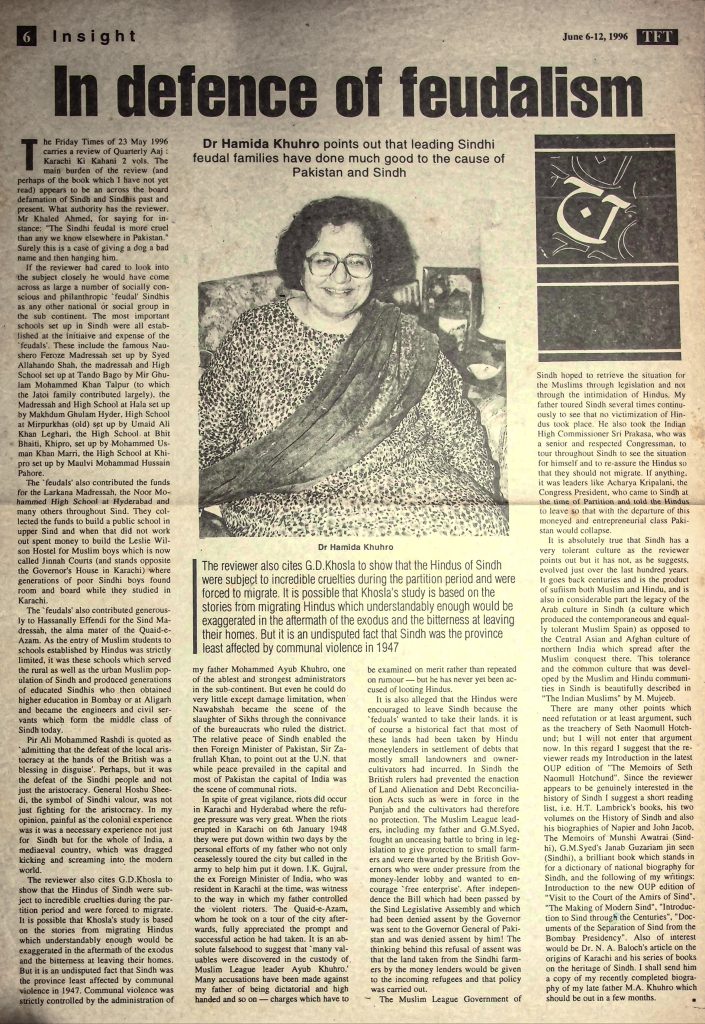
In defence of feudalism
Dr Hameeda Khuhro
The Friday Times of 23 May 1996 contains a review of Quarterly Aaj, Karachi ki Kahani’. A ‘note’ she attributes to me and which is not perhaps of the book which I have not yet seen. The review is an out and out defamation of Sindhi and Sindhis past and present. She is particularly critical of my review of Mr Khalid Ahmed, for saying for instance: ‘Dr Hamida Khuhro… tries to explain why we know elsewhere in Pakistan… mainly the creation of post partition Sindhi a bad name just does not apply here.’ If the reviewer had cared to look into the history of Sindh she would have come across as large a number of socially concerned Sindhi ‘feudals’, who, as much as any other national or social group in the sub-continent, set up educational schools set up in Sindh were all established by the generosity of ‘feudals’. These include the famous Naushahro Feroze Madressah, set up by Mian Ghulam Siddik, The Madressah and High School set up at Tando Bago by Mir Ghulam Mohammad Talpur (apart from the Jains family contributing largely), the Shah Latif secondary school at Mirpur Khas by Makhdum Ghulam Hyder. High School at Tandi Adam set up by Rais Ali Murad Khan Leghari, the High School at Bhit Shah, schools at Shah Bunder by Mirs Jan Mari, the High School at Khair-pur by Mirs. These are just a few examples. The ‘feudals’ also contributed handsomely to the Sindh Madressah and the Sind Muhammedan High School at Hyderabad and set up the trust to run them. Some landlords collected the funds to build a public school in memory of Noor Mohammad but the chief court spent money to build the Leslie Wilson (Muslim) Hostel. It was Sir Ghulam Hussain who collected Jinnah Courts (and stands opposite) was all given by him for educational purposes. Many generations of poor Sindhi boys found rooms to stay in while they studied in Karachi. The ‘feudals’ also contributed generously to the established of Sind College. Significantly, the alma mater of the Quaid-e-Azam, the Sindh Madressah, among other schools established by Hindus was strictly Sindhi in character. But the medium in all the rural as well as the urban Muslim populated schools established by ‘feudals’ was of educated Sindhis who then obtained higher education in Aligarh or in Europe and became the engineers and civil servants of Sindh who are blamed today for admitting to Mr Mohammed Rashdi is quoted as admitting that he found Sindhi character-less at the hands of the British. He was writing as a member of a generation after the defeat of the Sindhi people and not just its ‘feudals’, at the hands of the British, the symbol of Sindhi valour, was not just political or economic but, in his opinion, painful as the colonial experience had been. He found it painful as it had been for Sindh but for the whole of India, a unique civilisation was facing a gradual kicking and screaming into the modern times. The reviewer also cites G.D Khosla to show the incredible cruelties during partition to incredible cruelties during the partition period and to try and show Sindhis responsible for the partition. It is incredible that she should give credence to the stories from migrating Hindus about Sindhi ‘feudal’ attacks as she is exaggerated in the aftermath of the exodus and the bitterness at leaving their homes. But it is an undisputed fact that Sindh was the province least affected by communal violence in 1947. Communal violence was strictly controlled by the administration of my father Mohammed Ayub Khuhro, one of the foremost Muslim politicians in the sub-continent. But even he could do very little against demonstrating crowds. Nawabshah became the scene of the greatest violence because of ineptitude of the bureaucrats who ruled the district, Mr Masud, backed by the Hindu Finance Minister of Pakistan. Mr J.H. Fruitah Khosa is posing at the U.N. that he was a great ‘nationalist’. As a result of most of Pakistan the capital of India was being run from Karachi at in spite of great vigilance, riots did occur in Karachi on January 6, 1948, the refugee pressure was very great. When the riots started the streets, full of refugees, and they were put down within two days by the military. This is why I have been up and ceaselessly toured the city but called in the army on this particular occasion because the ex Foreign Minister of India, who was staying in Karachi at the time, was seeing to the way in which my father lived his life without police. The Quaid-e-Azam, when he returned from Peshawar afterwards, fully appreciated the prompt and effective action of my father’s absolute solute falsehood to suggest that many valuable lives were lost in the rioting. A Muslim League leader Ayub Khuhro. ‘When Pakistan came into being, he wrote my father of being dictatorial and high handed and so on — charges which have to be examined on merit rather than repeated ad nauseam. I have heard accounts because of bolting Hindus. It is also said to that the Hindus were encouraged to leave Sindh because the of order issued by my father was, of course a historical fact that most of the jobs in the urban areas of Sindh were held by the Hindu middle class — mostly small landowners and owner-cultivators working on their land. British rulers had prevented the enactment of land legislation to protect the tenancy tion Acts such as were in force in the Punjab, because the Hindu was their job no protection. The Muslim League leaders, including my father and G.M. Syed, fought an unceasing battle to bring in legislation to protect the hari. The landowners and were thwarted by the British government and the Hindu members, whose money lender lobby and wanted to ensure that land mortgagees could continue the bill which had been passed by the old Legislative Assembly and which had been sent by the Governor to Delhi was sent to the Governor General of Pakistan who gave his assent. In addition to thinking behind this refusal of assent was that the Hindu members were afraid that leaders by the money lenders would be given to the new government. This legislation was carried out The Muslim League Government of Sindh hoped to retrieve the situation for the Muslims of Sindh who had been lost through the intimidation of Hindus. My father used to point out he never lost an opportunity to see that no victimisation of Hindus took place. He used to point out the High Commissioner Sri Prakasam, who was a witness to his impartial tour throughout Sindh to see the situation for himself. My father also explained that they should not migrate. In anything, he told them, was not to leave their homes where he pointed out he could not guarantee the same. At Partition, he told that Sindhis were in exactly the same situation as the moneyed and entrepreneurial class Pakistan needs’. I think It is absolutely true that Sindh has a well defined culture of its own as she points out but it has not, as she suggests, degenerated at all. On the contrary, Sindh is going back centuries and is the product of more than 5000 years BC. It is far from being Arab in culture which she calls it. In fact, Arab culture in Sindh is culture which is influenced and integrated by the more tolerant Muslim Spain) as opposed to the intolerant and strictly fundamentalist northern India which spread after the Afghan conquest across the sub-continent and the common culture that was developed in time for the rest of the minorities. Ities in Sindh is beautifully described in ‘The Awakening of P.B. Shelley. There are many other points which are misleading in the review and which require lengthy reply and rebuttal. However, I will not enter that argument now as I am sure that a large section of the viewer readers my introduction to the latest SUN edition of ‘Recollections of Seth Naomall Hotchund’. Since the reviewer appears to be unacquainted with the history of Sindh I suggest a short reading list for her. 1. General reading of the volumes on the History of Sindh and also special studies of modern Sindh history. 2. The Memoirs of Mumlid. Awaniani (Sindhi). 3. Tareekh-e-Sindh Kalhora Dauran (Sindhi), a brilliant book which stands in class of its own on the history of Sindh. 4. Introduction to the new OUP edition of Lambrick’s classic book ‘Sindh: A General Introduction’. 5. My own book, ‘The Making of Modern Sindh’, ‘Introduction to Sindh Archives’ as well as 6. ‘Documents of the Separation of Sindh from Bombay Presidency’. Both by. Lastly, would be Dr. N. A. Baloch’s article on the culture of Sindh or his definitive biography of my late father M.A. Khuhro which is due out this summer. I suggest an article on the heritage of Sindh. I shall send him should be out in a few months.
