January 8-14, 199
books
Friday Times
12
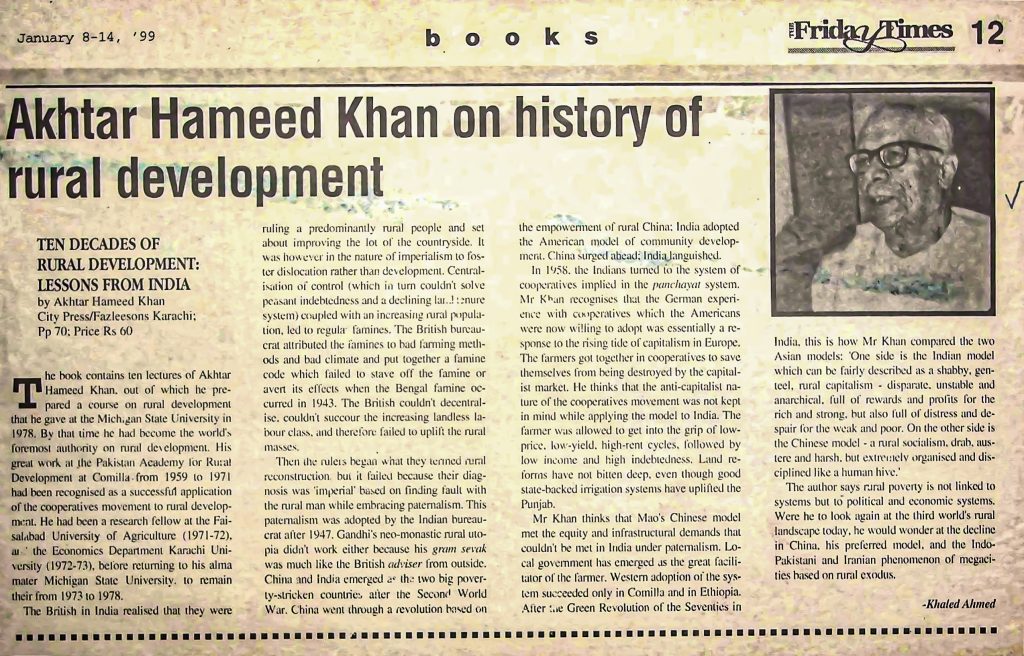
Akhtar Hameed Khan on history of rural development
TEN DECADES OF RURAL DEVELOPMENT: LESSONS FROM INDIA
by Akhtar Hameed Khan
City Press/Fazleesons Karachi:
Pp 70: Price Rs 60
T he book contains ten lectures of Akhtar Hameed Khan, out of which he pre-pared a course on rural development that he gave at the Michigan State University in 1978. By that time he had become the world’s foremost authority on rural development. His great work at the Pakistan Academy for Rural Development at Comilla from 1959 to 1971 had been recognised as a successful application of the cooperatives movement to rural develop-ment. He had been a research fellow at the Fai-salabad University of Agriculture (1971-72), a the Economics Department Karachi Uni-versity (1972-73), before returning to his alma mater Michigan State University, to remain their from 1973 to 1978.
The British in India realised that they were
ruling a predominantly rural people and set about improving the lot of the countryside. It was however in the nature of imperialism to fos-ter dislocation rather than development. Central-isation of control twhich in turn couldn’t solve peasant indebtedness and a declining lar.1: enure system) coupled with an increasing rural popula tion, led to regula famines. The British bureau-crat attributed the famines to bad farming meth-ods and bad climate and put together a famine code which failed to stave off the famine or avert its effects when the Bengal famine oc-curred in 1943. The British couldn’t decentral-ise. couldn’t succour the increasing landless la-bour class, and therefore failed to uplift the rural masses
Then the rulers began what they terrned rural reconstruction, but it failed because their diag-nosis was ‘imperial based on finding fault with the rural man while embracing paternalism. This paternalism was adopted by the Indian bureau-crat after 1947. Gandhi’s neo-monastic rural uto-pia didn’t work either because his gram sevak was much like the British adviser from outside. China and India emerged the two big pover-ty-stricken countries after the Second World War. China went through a revolution based on
the empowerment of rural China: India adopted the American model of community develop-ment. China surged abead: India Janguished.
In 1958, the Indians turned to the system of cooperatives implied in the panchayat system. Mr Khan recognises that the German experi-ence with cooperatives which the Americans were now willing to adopt was essentially a re-sponse to the rising tide of capitalism in Europe. The farmers got together in cooperatives to save themselves from being destroyed by the capital-ist market. He thinks that the anti-capitalist na-ture of the cooperatives movement was not kept in mind while applying the model to India. The farmer was allowed to get into the grip of low-price, low-yield, high-rent cycles, followed by low income and high indebtedness. Land re-forms have not bitten deep, even though good state-backed irrigation systems have uplifted the Punjab.
Mr Khan thinks that Mao’s Chinese model met the equity and infrastructural demands that couldn’t he met in India under paternalism. Lo-cal government has emerged as the great facili-tator of the farmer. Western adoption of the sys-tem succeeded only in Comilla and in Ethiopia. After te Green Revolution of the Seventies in
India, this is how Mr Khan compared the two Asian models: One side is the Indian model which can be fairly described as a shabby, gen-teel, rural capitalism disparate, unstable and anarchical, full of rewards and profits for the rich and strong, but also full of distress and de-spair for the weak and poor. On the other side is the Chinese modela rural socialism, drah, aus-tere and harsh, but extremely organised and dis-ciplined like a human hive.
The author says rural poverty is not linked to systems but to political and economic systems. Were he to look again at the third world’s rural landscape today, he would wonder at the decline in China, his preferred model, and the Indo-Pakistani and Iranian phenomenon of megaci ties based on rural exodus.
-Khaled Ahmed
(048) History Of Rural Development Review