The News International, Thursday, February 25, 1999
Making of a revolution and its aftermath
By Mohsin S. Jaffri
A mass movement bringing about drastic changes, politi-cally, socially, in ways of think-ing and methods of working, becomes known as a Revolu-tion. Our recent history calls the happenings in Iran – a revolution. The ingredients of revolution are: Popular unrest for reasons of; ex-treme poverty on mass scale, an un-just system of reward and punish-ment, unjust distribution of wealth and absolute power in the hands of a few, and a general sense of depriva tion among the masses. Iran had been harbouring all the ingredients for some time before the masses revolted against the monarchy and a com-pletely new system replaced the old under a new leadership. It is in this background that the book Shah of Shahs (Shahensha) picks up the story by presenting sketches of a nation in turmoil.
The author. Ryszard Kapuscinski, a senior Polish journalist, looks at the circumstances leading up to the Rev-olution and the aftermath. His novel style of writing, experienced method of projection, the trait of a good jour-nalist, is very much evident in the manner of presentation – a slide-show with narration.
Ajmal Kamal, the translator of this book, Shah of Shahs, himself a short story writer of repute, added his skill to preserve, as much as possible, the original character of Kapuscinski’s writings.
As I said earlier, the presentation is in a form of short sketches, more like identifiable patches on a broad canvas. The opening chapters pick up the story from photographs descrip-tion of what it shows, and from here the author succeeds in creating an im-pact of the prevailing conditions and what is to be expected later. It’s a re-markable projection technique that involves readers to build a picture and then to set-in the scattered pieces for a fuller view of events and its after-math.
The translator, Ajmal Kamal, him self an articulate writer, not only un derstands the mood but follows the technique too, making sure not to lose the original flavour while giving it a new attire- Urdu.
The first chapter, ‘Naam, Chehray, Phooloun kay takhtay, (Name, Faces and Flowerbeds) is the most empow-ing:
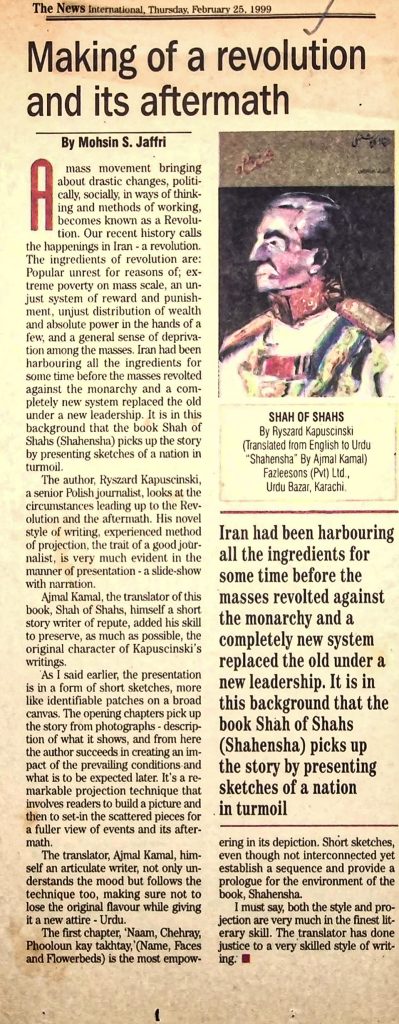
SHAH OF SHAHS
By Ryszard Kapuscinski (Translated from English to Urdu “Shahensha” By Ajmal Kamal) Fazleesons (Pvt) Ltd,. Urdu Bazar, Karachi.
Iran had been harbouring all the ingredients for some time before the masses revolted against the monarchy and a completely new system replaced the old under a new leadership. It is in this background that the book Shah of Shahs (Shahensha) picks up the story by presenting sketches of a nation in turmoil
ering in its depiction. Short sketches, even though not interconnected yet establish a sequence and provide a prologue for the environment of the book, Shahensha.
I must say, both the style and pro-jection are very much in the finest lit-erary skill. The translator has done justice to a very skilled style of writ-
(050) Shenshah Review