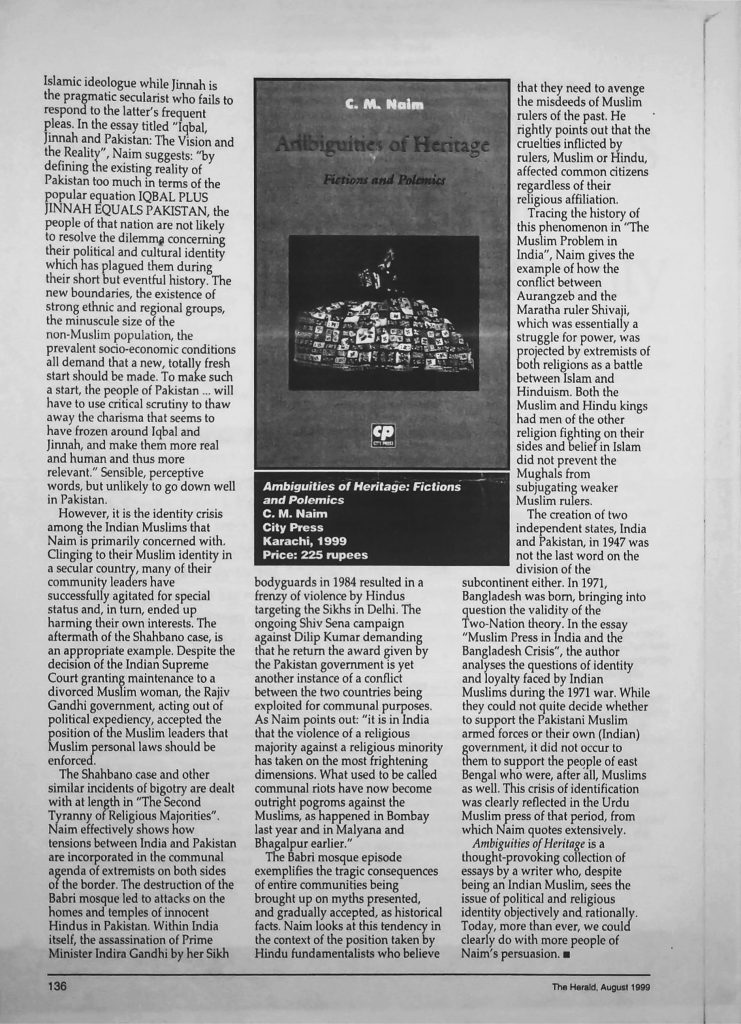
C. M. Naim
Anilbiguities of Heritage
Fictions and Polemict
Islamic ideologue while Jinnah is the pragmatic secularist who fails to respond to the latter’s frequent pleas. In the essay titled “Iqbal, Jinnah and Pakistan: The Vision and the Reality”, Naim suggests: “by defining the existing reality of Pakistan too much in terms of the popular equation IQBAL PLUS JINNAH EQUALS PAKISTAN, the people of that nation are not likely to resolve the dilemma concerning their political and cultural identity which has plagued them during their short but eventful history. The new boundaries, the existence of strong ethnic and regional groups, the minuscule size of the non-Muslim population, the prevalent socio-economic conditions all demand that a new, totally fresh start should be made. To make such a start, the people of Pakistan… will have to use critical scrutiny to thaw away the charisma that seems to have frozen around Iqbal and Jinnah, and make them more real and human and thus more relevant.” Sensible, perceptive words, but unlikely to go down well in Pakistan.
However, it is the identity crisis among the Indian Muslims that Naim is primarily concerned with. Clinging to their Muslim identity in a secular country, many of their community leaders have successfully agitated for special status and, in turn, ended up harming their own interests. The aftermath of the Shahbano case, is an appropriate example. Despite the decision of the Indian Supreme Court granting maintenance to a divorced Muslim woman, the Rajiv Gandhi government, acting out of political expediency, accepted the position of the Muslim leaders that Muslim personal laws should be enforced.
The Shahbano case and other similar incidents of bigotry are dealt with at length in “The Second Tyranny of Religious Majorities”. Naim effectively shows how tensions between India and Pakistan are incorporated in the communal agenda of extremists on both sides of the border. The destruction of the Babri mosque led to attacks on the homes and temples of innocent Hindus in Pakistan. Within India itself, the assassination of Prime Minister Indira Gandhi by her Sikh
Ambiguities of Heritage: Fictions and Polemics
C. M. Naim
City Press Karachi, 1999
Price: 225 rupees
bodyguards in 1984 resulted in a frenzy of violence by Hindus targeting the Sikhs in Delhi. The ongoing Shiv Sena campaign against Dilip Kumar demanding that he return the award given by the Pakistan government is yet another instance of a conflict between the two countries being exploited for communal purposes. As Naim points out: “it is in India that the violence of a religious majority against a religious has taken on the most frightening dimensions. What used to be called communal riots have now become outright pogroms against the Muslims, as happened in Bombay last year and in Malyana and Bhagalpur earlier.” minority
The Babri mosque episode exemplifies the tragic consequences of entire communities being brought up on myths presented, and gradually accepted, as historical facts. Naim looks at this tendency in the context of the position taken by Hindu fundamentalists who believe
that they need to avenge the misdeeds of Muslim rulers of the past. He rightly points out that the cruelties inflicted by rulers, Muslim or Hindu, affected common citizens regardless of their religious affiliation.
Tracing the history of this phenomenon in “The Muslim Problem in India”, Naim gives the example of how the conflict between Aurangzeb and the Maratha ruler Shivaji, which was essentially a struggle for power, was projected by extremists of both religions as a battle between Islam and Hinduism. Both the Muslim and Hindu kings had men of the other religion fighting on their sides and belief in Islam did not prevent the Mughals from subjugating weaker Muslim rulers.
The creation of two independent states, India and Pakistan, in 1947 was not the last word on the division of the subcontinent either. In 1971, Bangladesh was born, bringing into question the validity of the Two-Nation theory. In the essay “Muslim Press in India and the Bangladesh Crisis”, the author analyses the questions of identity and loyalty faced by Indian Muslims during the 1971 war. While they could not quite decide whether to support the Pakistani Muslim armed forces or their own (Indian) government, it did not occur to them to support the people of east Bengal who were, after all, Muslims as well. This crisis of identification was clearly reflected in the Urdu Muslim press of that period, from which Naim quotes extensively.
Ambiguities of Heritage is a thought-provoking collection of essays by a writer who, despite being an Indian Muslim, sees the issue of political and religious identity objectively and rationally. Today, more than ever, we could clearly do with more people of Naim’s persuasion.
136
The Herald, August 1999
image60