
books
By Leon Menezes
The Crisis of Identity
C.M. Naim makes a foray into the politics of identity.
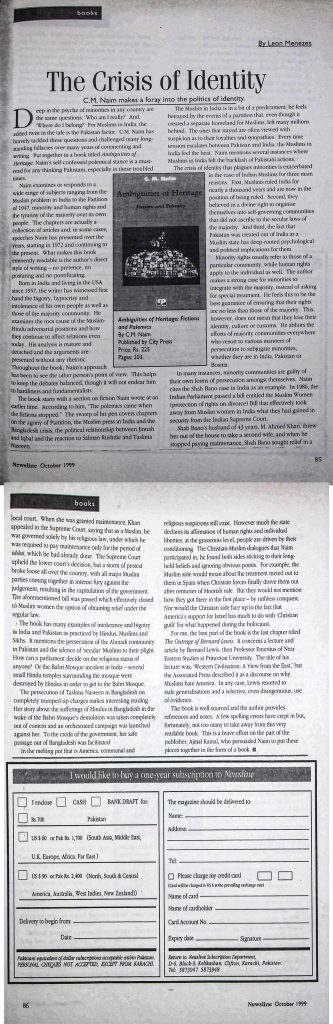
D eep in the psyche of minorities in any country are the same questions. Who am I really?” And, Where do I belong?” For Muslims in India, the added twist in the tale is the Pakistan factor. C.M. Naim has bravely tackled these questions and challenged many long-standing fallacies over many years of commenting and writing. Put together in a book titled Ambiguities of Heritage. Naim’s self-confessed polemical stance is a must-read for any thinking Pakistani, especially in these troubled times.
Naim examines or responds to a wide range of subjects ranging from the Muslim problem in India to the Partition of 1947, minority and human rights and the tyranny of the majority over its own people. The chapters are actually a collection of articles and, in some cases, speeches Naim has presented over the years, starting in 1972 and continuing to the present. What makes this book eminently readable is the author’s direct style of writing-no pretence, no posturing and no pontificating.
Born in India and living in the USA since 1957, the writer has witnessed first hand the bigotry, hypocrisy and intolerance of his own people as well as those of the majority community. He examines the root cause of the Muslim-Hindu adversarial positions and how they continue to affect relations even today. His analysis is mature and detached and the arguments are presented without any rhetoric.
Throughout the book, Naim’s approach has been to see the other person’s point of view. This helps to keep the debates balanced, though it will not endear him to hardliners and fundamentalists.
The book starts with a section on fiction Naim wrote at an earlier time. According to him, “The polemics came when the fictions stopped.” The sweep of his pen covers chapters on the agony of Partition, the Muslim press in India and the Bangladesh crisis, the political relationship between Jinnah and Iqbal and the reaction to Salman Rushdie and Taslima Nasreen.
Fizzione and Poleraica
cp
Ambiguities of Heritage: Fictions
and Polemics. By C.M. Naim Published by City Press Price: Rs. 225 Pages: 203.
The Muslim in India is in a bit of a predicament; he feels betrayed by the events of a partition that, even though it created a separate homeland for Muslims, left many millions behind. The ones that stayed are often viewed with suspicion as to their loyalties and sympathies. Every time tension escalates between Pakistan and India, the Muslims in India feel the heat. Naim mentions several instances where Muslims in India felt the backlash of Pakistani actions.
- M. Naim
Ambiguities of Heritage nearly a thousand years and are now in the
The crisis of identity that plagues minorities is exacerbated in the case of Indian Muslims for three main reasons. First, Muslims ruled India for position of being ruled. Second, they believed in a divine right to organise themselves into self-governing communities that did not ascribe to the secular laws of the majority. And third, the fact that Pakistan was created out of India as a Muslim state has deep-rooted psychological and political implications for them.
Minority rights usually refer to those of a particular community, while human rights apply to the individual as well. The author makes a strong case for minorities to integrate with the majority, instead of asking for special treatment. He feels this to be the best guarantee of ensuring that their rights are no less than those of the majority. This, however, does not mean that they lose their identity, culture or customs. He abhors the efforts of majority communities everywhere who resort to various manners of persecution to subjugate minorities, whether they are in India, Pakistan or Bosnia.
In many instances, minority communities are guilty of their own forms of persecution amongst themselves. Naim cites the Shah Bano case in India as an example. In 1986, the Indian Parliament passed a bill entitled the Muslim Women (protection of rights on divorce) Bill that effectively took away from Muslim women in India what they had gained in security from the Indian Supreme Courn.
Shah Bano’s husband of 43 years, M. Ahmed Khan, threw her out of the house to take a second wife, and when he stopped paying maintenance, Shah Bano sought relief in a
85
Newsline October 1999
books
local court. When she was granted maintenance, Khan appealed to the Supreme Court, saying that as a Muslim, he was governed solely by his religious law, under which he was required to pay maintenance only for the period of iddat, which he had already done. The Supreme Court upheld the lower court’s decision, but a storm of protest broke loose all over the country, with all major Muslim parties coming together in intense fury against the
judgement, resulting in the capitulation of the government. The aforementioned bill was passed which effectively closed to Muslim women the option of obtaining relief under the regular law.
The book has many examples of intolerance and bigotry in India and Pakistan as practiced by Hindus, Muslims and Sikhs. It mentions the persecution of the Ahmadi community in Pakistan and the silence of ‘secular Muslims to their plight.
How can a parliament decide on the religious status of anyone? Or the Babri Mosque incident in India-several small Hindu temples surrounding the mosque were destroyed by Hindus in order to get to the Babri Mosque.
The persecution of Taslima Nasreen in Bangladesh on completely trumped-up charges makes interesting reading Her story about the sufferings of Hindus in Bangladesh in the wake of the Babri Mosque’s demolition was taken completely out of context and an orchestrated campaign was launched against her. To the credit of the government, her safe passage out of Bangladesh was facilitated.
In the melting pot that is America, communal and
religious suspicions still exist. However much the state declares its affirmation of human rights and individual liberties, at the grassroots level, people are driven by their conditioning. The Christian-Muslim dialogues that Naim participated in, he found both sides sticking to their long-held beliefs and ignoring obvious points. For example, the Muslim side would moan about the treatment meted out to them in Spain when Christian forces finally drove them out after centuries of Moorish rule. But they would not mention
how they got there in the first place-by ruthless conquest. Nor would the Christian side face up to the fact that America’s support for Israel has much to do with ‘Christian guilt for what happened during the holocaust.
For me, the best part of the book is the last chapter titled The Outrage of Bernard Lewis. It concerns a lecture and article by Bernard Lewis, then Professor Emeritus of Near Eastern Studies at Princeton University. The title of his lecture was, ‘Western Civilisation: A View from the East,’ but the Associated Press described it as a discourse on why Muslims hate America. In any case, Lewis resorted to stale generalisations and a selective, even disingenuous, use of evidence.
The book is well sourced and the author provides references and notes. A few spelling errors have crept in but, fortunately, not too many to take away from this very readable book. This is a brave effort on the part of the publisher, Ajmal Kamal, who persuaded Naim to put these pieces together in the form of a book.
I would like to buy a one-year subscription to Newsline
I enclose
CASH
BANK DRAFT for:
Rs 700
Pakistan
US $ 60 or Pak Rs. 1,700 (South Asia, Middle East,
U.K. Europe, Africa. Far East)
Tel
US $ 90 or Pak Rs. 2,400 (North, South & Central
America, Australia, West Indies, New Zealand))
The magazine should be delivered to:
Name:
Address:
Please charge my credit card
(Card will be charged in US $ ar the prevailing exchange rate)
Name of card
Name of cardholder
Card Account No.
Delivery to begin from:
Date:
Expiry date
Signature
Pakistani equivalent of dollar subscriptions acceptable within Pakistan. PERSONAL CHEQUES NOT ACCEPTED, EXCEPT FROM KARACHI.
Return to: Neusline Subscription Department,
D-6, Block-9, Kebkashan, Clifton, Karachi, Pakistan..
Tel: 5873947 5873948
86
Newsline October 1999
