LITERATI
By Asif Farrukhi
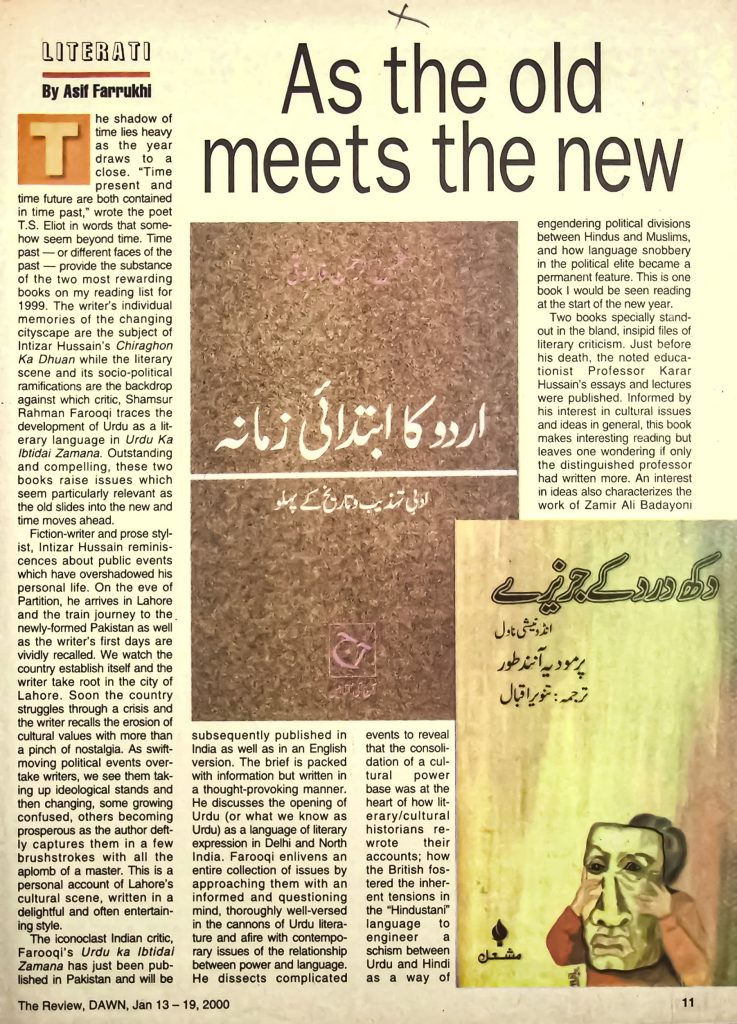
T time lies heavy as the year close. “Time present and time future are both contained in time past, wrote the poet T.S. Eliot in words that some-how seem beyond time. Time pastor different faces of the past provide the substance of the two most rewarding books on my reading list for 1999. The writer’s individual memories of the changing cityscape are the subject of Intizar Hussain’s Chiraghon Ka Dhuan while the literary scene and its socio-political ramifications are the backdrop against which critic, Shamsur Rahman Farooqi traces the development of Urdu as a lit-erary language in Urdu Ka Ibtidai Zamana. Outstanding and compelling, these two books raise issues which seem particularly relevant as the old slides into the new and time moves ahead.
he shadow of
Fiction-writer and prose styl-ist, Intizar Hussain reminis-cences about public events which have overshadowed his personal life. On the eve of Partition, he arrives in Lahore and the train journey to the newly-formed Pakistan as well as the writer’s first days are vividly recalled. We watch the country establish itself and the writer take root in the city of Lahore. Soon the country struggles through a crisis and the writer recalls the erosion of cultural values with more than a pinch of nostalgia. As swift-moving political events over-take writers, we see them tak-ing up ideological stands and then changing, some growing confused, others becoming prosperous as the author deft-ly captures them in a few brushstrokes with all the aplomb of a master. This is a personal account of Lahore’s cultural scene, written in a delightful and often entertain ing style.
The iconoclast Indian critic, Farooqi’s Urdu ka Ibtidal Zamana has just been pub-lished in Pakistan and will be
The Review, DAWN, Jan 13-19, 2000
As the old meets the new
اردو کا ابتدائی زمانہ
ادبی تہذیب و تاریخ کے پہلو
subsequently published in India as well as in an English version. The brief is packed with information but written in a thought-provoking manner. He discusses the opening of Urdu (or what we know as Urdu) as a language of literary expression in Delhi and North India. Farooqi enlivens an entire collection of issues by approaching them with an informed and questioning mind, thoroughly well-versed in the cannons of Urdu litera-ture and afire with contempo-rary issues of the relationship between power and language. He dissects complicated
events to reveal that the consoli-dation of a cul-tural power base was at the heart of how lit-erary/cultural historians re-wrote their accounts; how the British fos-tered the inher-ent tensions in the “Hindustani” language engineer schism between Urdu and Hindi as a way of to a
engendering political divisions between Hindus and Muslims, and how language snobbery in the political elite became a permanent feature. This is one book I would be seen reading at the start of the new year.
Two books specially stand-out in the bland, insipid files of literary criticism. Just before his death, the noted educa-tionist Professor Karar Hussain’s essays and lectures were published. Informed by his interest in cultural issues and ideas in general, this book makes interesting reading but leaves one wondering if only the distinguished professor had written more. An interest in ideas also characterizes the work of Zamir Ali Badayoni
دکھ درد کے جزیرے
انه دنیشی ناول
پرمود یه آنند طور ترجمه : تنویر اقبال
مشعل
11
image65